Commercial Building Security Plan: How to Cover Lobby + Patrol Efficiently
Introduction: The Core Challenge of Modern Building Security
For property managers, facility directors, and building owners, securing a commercial property presents a unique operational puzzle. The lobby is your public face and primary point of control—a hub for tenants, visitors, and deliveries that requires constant, vigilant oversight. Simultaneously, the vast, often empty spaces beyond—hallways, stairwells, parking garages, and mechanical rooms—demand regular, proactive patrols to deter threats and identify vulnerabilities. The core challenge is achieving comprehensive coverage without a bloated security budget. How do you ensure your lobby is never left unattended while still maintaining an effective, unpredictable patrol presence throughout the property? An ineffective plan leads to blind spots, security breaches, tenant complaints, and increased liability. This guide provides the definitive solution. We will outline a strategic commercial building security plan that seamlessly integrates robust lobby procedures with intelligent patrol routing, empowering you to maximize coverage, efficiency, and safety with the resources you have.
What Is a Commercial Building Security Plan?
A commercial building security plan is a formal, living document that outlines the policies, procedures, personnel assignments, and technology used to protect a property, its assets, and its occupants. It’s not merely a list of rules; it’s an operational blueprint that aligns your security resources with your specific risks.
Critical Components of an Effective Plan:
- Risk Assessment: Identifying your property’s unique vulnerabilities (e.g., multiple entrances, public access retail, underground parking).
- Layered Defense Strategy: Implementing concentric rings of security, from the perimeter (fencing, lighting) to the core (server rooms, executive floors).
- Clear Staffing & Post Orders: Defining exactly what each guard is responsible for and when.
- Technology Integration: Specifying how access control, CCTV, and alarm systems support and are monitored by human personnel.
- Emergency & Incident Response Protocols: Providing clear steps for fires, medical emergencies, threats, and other critical events.
Without this cohesive plan, security becomes reactive, inconsistent, and full of gaps that criminals can exploit.
Common Security Risks in Commercial Building Lobbies
The lobby is your first and most critical line of defense. Understanding the threats here is key to crafting effective lobby security procedures.
Primary Lobby Risks:
- Unauthorized Entry (Tailgating): The #1 threat. An individual follows an authorized person through a secured door without presenting credentials.
- Imposters & Social Engineering: Individuals posing as delivery personnel, contractors, or even executives to gain access to restricted areas.
- Package Theft: Theft of delivered parcels from mailrooms or front desk areas.
- Aggressive or Disruptive Individuals: Former employees, disgruntled visitors, or individuals experiencing a crisis causing a disturbance.
- Espionage & Corporate Theft: Unauthorized individuals attempting to access tenant offices to steal intellectual property or sensitive information.
- Terrorism & Violence: While rare, lobbies are soft targets for acts of violence, requiring proactive monitoring and threat detection.
A secure lobby acts as a filter, ensuring only authorized individuals proceed into the building while providing a safe, professional environment for all.
Lobby Security Procedures Every Commercial Building Should Have
Your lobby is a controlled environment, not a passive space. These front desk security procedures are non-negotiable.
1. Access Control Enforcement:
- Mandatory Credential Presentation: Every person entering beyond the lobby must visibly display or swipe their access card/key fob. The guard must verify this action.
- Tailgating Prevention Protocol: Guards must be trained to politely challenge any individual who does not personally badge in. A standard script: “Excuse me, sir/ma’am, I need to see your access credential, please.”
2. Visitor Management System:
- All visitors must be processed. This includes deliveries, contractors, interviewees, and guest meetings.
- Procedure: Visitor presents ID → Guard logs details (name, company, time, tenant visited) → Guard contacts tenant for verification → Issues a temporary, visibly distinct badge → Logs badge return upon exit.
3. Package & Delivery Management:
- Designate a secure package room or locked storage behind the front desk.
- Log all deliveries (courier, tracking #, recipient, time).
- Never leave packages unattended in the public lobby.
4. Observation & Engagement:
- The guard should maintain a position with a clear view of all entry points and the lobby floor.
- Practice “controlled observation”—making brief, professional eye contact with everyone who enters. This registers presence and acts as a deterrent.
- Be a proactive source of information and assistance to legitimate tenants and guests.
How to Cover Lobby + Patrol Efficiently With Limited Guards
This is the central efficiency challenge. You cannot leave the lobby unmanned, yet the building must be patrolled. The solution lies in smart scheduling, technology, and procedural design.
Strategy 1: The “Fixed Post with Patrol Blocks” Model (Most Common)
- The guard’s primary post is the lobby desk.
- Patrols are conducted during predetermined, brief “coverage blocks” (e.g., 15 minutes every hour).
- During a patrol block: The guard performs a quick but thorough patrol of a designated zone. The lobby is not left “uncovered” if you use technology:
- Temporary Access Control: Lock the main interior doors during patrol, requiring tenants to use their key cards (they should be doing this anyway).
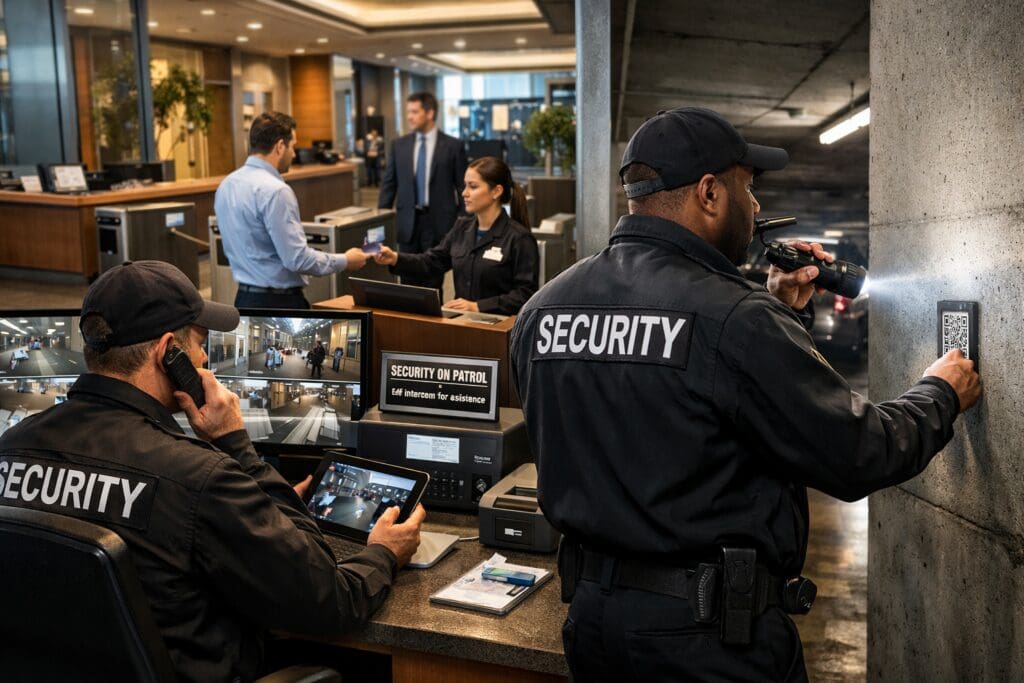
- Signage: A small sign at the desk: “Security on patrol. For immediate assistance, please use the intercom/call [phone number].”
- Remote Video Verification: The guard carries a tablet linked to the building’s CCTV and can view the lobby camera live during the patrol.
Strategy 2: The “Roving Lobby Post” for Smaller Buildings
- The guard is not anchored to a desk. They stand or move within the lobby area.
- Patrols are shorter, more frequent “perimeter sweeps” (e.g., checking main floor corridors, exterior doors, and mailrooms every 30 minutes).
- The guard remains in or immediately adjacent to the lobby, maintaining visual control while extending their presence slightly.
Strategy 3: The “Dedicated Rover” for Large or High-Risk Properties
- This is a two-guard minimum model.
- Guard 1: Static post at the lobby, handling all access control and visitor management.
- Guard 2: Dedicated to patrols, covering the entire property on an unpredictable schedule. They are the eyes and ears beyond the lobby and respond to incidents.
The key to all strategies is unpredictability. Publish the guard’s general responsibilities, but never the exact patrol timing.
Security Patrol Routes for Buildings: How to Plan Smarter Patrol Rounds
A patrol is not a leisurely walk. It’s a tactical inspection. Effective security patrol routes for buildings are deliberate and systematic.
Principles of Smart Route Planning:
- Zoning: Divide the property into logical zones (e.g., Parking Garage A, Floors 1-5, Floors 6-10, Roof Mechanical). Patrol one zone completely per round.
- Checkpoint System: Use a digital guard tour system or physical tamper-evident checkpoints (NFC tags, QR codes) at critical locations: roof doors, electrical rooms, stairwell landings, fire panel locations. The guard must scan/tag each point to prove presence.
- Varied Timing & Direction: Never patrol the same route at the same time or in the same direction. Go clockwise one round, counter-clockwise the next. Start patrols at random minutes past the hour.
- Focus on Vulnerabilities: Routes should prioritize high-risk areas: blind spots in parking garages, secluded stairwells, unoccupied tenant spaces under construction, and perimeter doors.
Sample Patrol Route Task: At the “4th Floor East Stairwell” checkpoint, the guard’s task isn’t just to scan. It’s to: 1) Check that the door closes and locks automatically. 2) Look for signs of loitering or vandalism. 3) Ensure no fire extinguishers are missing or tampered with.
Security Patrol Schedule Examples (Day Shift vs Night Shift)
Patrol frequency must match the risk profile of the shift.
Day Shift Patrol Schedule (High Activity, Focus on Access & Policy):
- Primary Focus: Lobby access control and vendor/visitor management.
- Patrol Frequency: Lighter, but strategic. Example: One full building interior patrol mid-morning, one exterior/perimeter patrol after lunch.
- Patrol Emphasis: Checking that occupied tenant spaces have properly closed doors, monitoring loading dock activity, ensuring fire exits are not propped open.
Night Shift Patrol Schedule (Low Activity, Focus on Deterrence & Inspection):
- Primary Focus: Asset protection, trespasser deterrence, and thorough building integrity checks.
- Patrol Frequency: Higher and unpredictable. Example: A full interior/exterior patrol every 90-120 minutes, with timing randomized.
- Patrol Emphasis: Checking all perimeter doors and windows, inspecting dark corners of parking garages, verifying that cleaning crews are authorized, testing door locks, looking for water leaks or HVAC issues.
Visitor Management System: Controlling Guests, Deliveries, and Contractors
A manual paper log is insufficient. A modern visitor management system for buildings is software that streamlines security and creates a digital audit trail.
How an Effective System Works:
- Pre-Registration: Tenants can pre-register guests online, sending them a QR code for arrival.
- ID Scanning & Capture: Upon arrival, the guard scans the visitor’s government ID. The system auto-populates their data and takes a photo for the badge.
- Automated Tenant Notification: The system sends an instant SMS or email notification to the host tenant: “Your guest [Name] has arrived.”
- Badge Printing: The system prints a temporary badge with the visitor’s name, photo, date, and access level (e.g., “Escort Required”).
- Comprehensive Reporting: You have a digital record of every visitor, contractor, and delivery person who entered the building, searchable by date, tenant, or name.
This system turns the guard from a data-entry clerk into an empowered verification officer, dramatically improving front desk security procedures.
How to Prevent Tailgating and Unauthorized Entry at the Lobby
Tailgating defeats even the most expensive access control system. Prevention requires a combination of technology, design, and human procedure.
1. Physical Design Solutions:
- Mantraps / Security Vestibules: A double-door entry system where the outer door must close and lock before the inner door can be opened. The guard can visually verify one person per credential.
- Optical Turnstiles: Barriers that allow only one person to pass per valid credential swipe.
2. Procedural & Human Solutions:
- Guard Training: Guards must be empowered and required to challenge every instance of potential tailgating. Use a standard, polite phrase.
- Tenant Education: Regularly communicate to tenants: “You are responsible for your credential. Do not hold the door for others. Report lost cards immediately.”
- Signage: Place clear signs at entrances: “Do not allow others to follow you in. All persons must badge in individually.”
3. Technological Solutions:
- Tailgating Detection Sensors: Specialized sensors above doors can detect if more than one person passes on a single credential and trigger an alarm at the security desk.
CCTV Monitoring for Commercial Buildings: What to Watch and When
CCTV is a force multiplier, not a replacement for guards. Its effectiveness depends on strategic use.
Lobby Camera Monitoring:
- The guard should not stare continuously at a bank of monitors. Instead, the lobby camera feed should be on a monitor at the desk for live reference.
- Use camera analytics if available: “Line Crossing” alerts can notify the guard if someone enters a restricted area after hours.
Patrol Support & Investigation:
- During Patrols: The guard can use a mobile device to pull up live feeds of the area they just left or are about to enter.
- Post-Incident: The primary value of CCTV is forensic. After an incident, guards and management can review footage to identify what happened, who was involved, and how to prevent recurrence.
Camera Placement Priorities: Cover all entry/exit points, lobbies, elevator banks, parking garage elevators and stairwells, loading docks, and main corridors. Ensure camera views are not obstructed by decor or plants.
Access Control System Setup for Office Buildings (Doors, Elevators, Floors)
A modern building access control system is the electronic backbone of your security plan.
Best Practice Setup:
- Perimeter Doors: Key card access only, 24/7. Logs all entries/exits.
- Elevators: Use elevator access control. Tenants badge in the lobby to call an elevator, and the system only allows access to their authorized floor(s). This prevents unauthorized access to tenant floors from the garage.
- Tenant Floors: Depending on the lease, interior stairwell doors may be locked from the stairwell side, requiring re-entry via a key card on each tenant floor.
- Time-Based Permissions: Contractor badges can be programmed to work only on specific days and times (e.g., Monday-Friday, 8 AM – 5 PM).
This layered approach ensures that a lost or stolen credential has limited usefulness and creates a detailed audit trail of movement throughout the property.
Security Guard Reporting Procedure + Incident Log Best Practices
Documentation is critical for liability, trend analysis, and continuous improvement. A standardized security guard reporting procedure is essential.
Daily Activity Log (DAL): A running log of all notable activities, even routine ones.
- Format: Time | Location | Activity / Observation | Action Taken | Guard Initials
- Example: 14:30 | Main Lobby | Assisted lost delivery for Tenant 501. Called tenant escort. | Delivery completed. | J.S.
Incident Report: Used for any security-related event: theft, trespass, accident, property damage, etc.
- Must Include: Precise date/time, location, persons involved (with descriptions), witness names, detailed narrative of events, actions taken, and evidence collected (e.g., “CCTV footage from Cam 12 preserved”).
Digital is Mandatory: Use a cloud-based reporting system. Paper logs get lost, are unreadable, and cannot be easily audited or analyzed for patterns.
Commercial Building Security Checklist (Lobby + Patrol Coverage)
Use this actionable checklist to audit or build your plan.
Lobby Security & Access Control:
- Access control system is installed on all perimeter doors.
- Clear visitor management policy and system (digital preferred) is in place.
- Guard post orders detail tailgating prevention and challenge procedure.
- Package handling procedures prevent theft.
- Lobby CCTV provides clear, recorded coverage of all entry points and the front desk.
Patrol Coverage & Routing:
- Property is divided into logical patrol zones.
- A digital guard tour system with checkpoints is deployed.
- Patrol routes and schedules are documented, with emphasis on randomness.
- Day vs. Night shift patrol frequencies are defined and differ based on risk.
- Patrol tasks at each checkpoint are specified (e.g., “check door lock, look for debris”).
Systems & Communication:
- Guards have reliable two-way radios or communication devices.
- CCTV system is monitored live at the lobby desk and accessible via mobile.
- Emergency contact list for tenants, management, and police/fire is readily available.
- A clear, digital reporting procedure for daily logs and incidents is established.
Staffing & Training:
- Security coverage plan details how lobby and patrol duties are covered per shift.
- Guards are trained on all post orders, access control systems, and emergency response plans.
- A process for regular plan review and update (at least annually) is in place.
Conclusion: Integrating Your Layers for Maximum Efficiency
A truly effective commercial building security plan is a symphony, not a solo performance. It harmonizes the constant, vigilant rhythm of lobby security procedures with the proactive, sweeping melody of intelligent security patrol routes for buildings. Success is measured not by the absence of incidents alone, but by the seamless integration of people, process, and technology to create an environment where safety is inherent and operations run smoothly. By implementing the strategies outlined—from smart staffing models and visitor management systems to digital patrol verification—you transform security from a reactive cost center into a proactive, value-driven asset that protects your property, your tenants, and your reputation. Don’t let inefficiency be your weakest link.
Ready to implement a comprehensive, efficient security plan tailored to your commercial property? Contact Us today for a free security assessment and a customized plan that optimizes your lobby coverage and patrol strategy.
FAQs
What should be included in a commercial building security plan?
A comprehensive ommercial building security plan must include: a site-specific risk assessment, detailed lobby access control and visitor procedures, defined security patrol routes and schedules, specifications for access control and CCTV systems, clear security guard post orders for all shifts, an incident reporting and emergency response protocol, and a staffing plan that outlines how lobby and patrol duties are covered.
How can one security guard cover both lobby and patrol?
The most effective method is the “Fixed Post with Patrol Blocks” model. The guard’s primary post is the lobby. During scheduled, brief patrol blocks (e.g., 15 minutes hourly), they conduct a focused patrol of a zone. The lobby remains secured via locked interior doors, temporary signage, and the guard’s ability to monitor lobby CCTV via a mobile device during the round. Patrol timing should be randomized.
How often should security guards patrol an office building?
Frequency depends on the shift and risk. During day shifts with high tenant activity, 1-2 full building patrols may suffice, with a focus on policy enforcement. During night shifts, patrols should be more frequent (e.g., every 90-120 minutes) and completely unpredictable to deter crime. All patrols should use a checkpoint system to verify completion.
What are the duties of a lobby security guard?
Key lobby security guard duties include: enforcing access control and preventing tailgating, managing all visitors and deliveries through a formal system, monitoring CCTV feeds, providing excellent customer service to tenants and guests, conducting periodic perimeter checks from their post, and serving as the first point of contact and response for all security incidents.
What is the best visitor management process for office buildings?
The best process uses a digital visitor management system. It should allow for pre-registration, require ID scanning upon arrival, automatically notify the host tenant, print a temporary photo badge, and maintain a secure digital log of all entries and exits. This creates efficiency, enhances security, and provides a clear audit trail, far surpassing paper logbooks.