Why Do Criminals Target Some Businesses And Ignore Others?
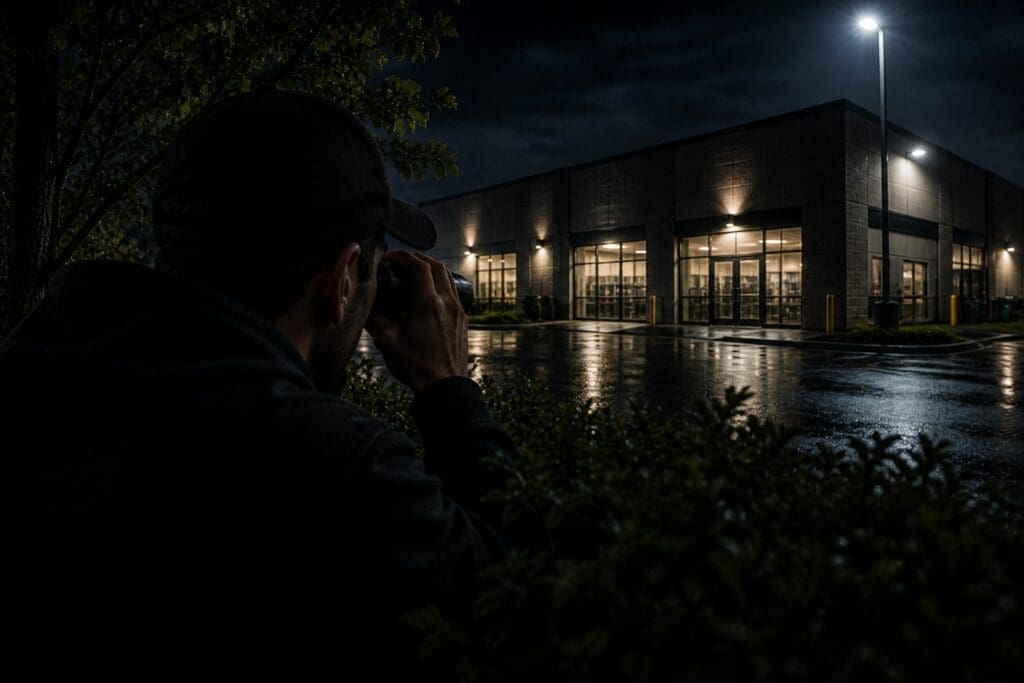
What experienced criminals notice in seconds—and how smart businesses make themselves harder targets.
Many business owners believe crime happens randomly.
It doesn’t.
In most cases, criminals don’t simply walk around looking for any building to target.
They study.
They observe.
They compare.
And then they choose the business that looks easiest to access… easiest to predict… and easiest to escape from.
That means your business may be judged in seconds—often before anyone ever notices.
So why do criminals target some businesses and completely ignore others?
Let’s break down what they often look for.
1. Poor Lighting Creates Easy Opportunities
Darkness creates confidence for criminals.
When parking lots, side entrances, loading docks, alleyways, rear exits, and dumpster areas are poorly lit, they create natural hiding spots.
Poor lighting can make it harder for:
- Employees to notice suspicious activity
- Security cameras to capture clear footage
- Passersby to witness unusual behavior
- Law enforcement to identify suspects
Businesses at risk:
- Warehouses
- Office buildings
- Retail stores
- Medical facilities
- Construction sites
- Apartment complexes
Security tip:
Install bright LED lighting with motion detection around vulnerable exterior zones.
2. No Visible Security Presence
Criminals prefer low-risk opportunities.
If your business has:
- No visible security guards
- No patrol vehicles
- No surveillance signage
- No active monitoring
- No visible deterrents
It may appear easier to approach.
A visible security presence often makes criminals move on before attempting anything.
Security tip:
Visible deterrence is one of the most powerful crime prevention tools.
3. Predictable Daily Routines
Criminals love routine.
Why?
Because routine creates opportunity.
If your business:
- Opens at the exact same time
- Closes with the same staff every night
- Turns lights off immediately after closing
- Receives deliveries on fixed schedules
- Conducts patrols at predictable times
Those patterns can be studied.
Security tip:
Randomize:
- Patrol schedules
- Closing procedures
- Staff exits
- Lighting schedules
Unpredictability creates uncertainty.
And criminals hate uncertainty.
4. Easy Access Points
Many break-ins happen through the places business owners forget to check.
Criminals look for:
- Unlocked side doors
- Weak rear entrances
- Damaged gates
- Broken fences
- Basement access points
- Poorly secured windows
- Loading docks
One vulnerable entry point can compromise an entire property.
Security tip:
Inspect every access point regularly—not just your front entrance.
5. Limited Or Poor Camera Coverage
Criminals often look for blind spots before making a move.
They study:
- Camera angles
- Coverage gaps
- Night visibility
- Exterior blind corners
- Parking lot coverage
If they can move without being seen…
That becomes an opportunity.
Security tip:
Audit your surveillance system regularly and eliminate blind spots.
6. Employees Share Too Much Information
Sometimes criminals don’t need cameras.
They simply ask questions.
Questions like:
- “What time do you close?”
- “Who stays late?”
- “Do deliveries come after hours?”
- “Is anyone here overnight?”
Small conversations can reveal valuable operational details.
Security tip:
Train employees on operational security awareness.
7. Blind Spots Around The Property
Criminals love areas where people rarely look.
This includes:
- Rear parking lots
- Side alleys
- Utility rooms
- Dumpster zones
- Emergency exits
- Service entrances
These locations often become staging areas.
Security tip:
Combine lighting, cameras, and physical patrols in vulnerable zones.
8. Slow Or No Security Response
Criminals test response times.
Sometimes they:
- Pull on doors
- Trigger motion areas
- Loiter nearby
- Check gates
- Observe staff reactions
If nobody responds…
They learn.
Security tip:
Every suspicious event should trigger visible action.
9. Businesses That Look Unprepared
Sometimes criminals make decisions based purely on appearance.
A business that appears:
- Dark
- Quiet
- Unmonitored
- Understaffed
- Poorly maintained
- Easy to approach
May become more attractive.
Meanwhile, businesses with visible protection often get skipped entirely.
What Makes A Business A Hard Target?
Businesses criminals often avoid usually have:
✔ Bright exterior lighting
✔ Visible security professionals
✔ Active surveillance systems
✔ Controlled access points
✔ Random patrol schedules
✔ Security-aware employees
✔ Fast response protocols
✔ Professional risk assessments
That’s where Churchgate Protective Services helps businesses stay ahead with:
- Licensed security professionals
- Mobile patrol services
- Risk-based security planning
- 24/7 surveillance support
- Access control solutions
- Customized protection strategies
Would Your Business Look Easy… Or Difficult?
Ask yourself:
- Could someone approach unnoticed?
- Are your routines predictable?
- Are your blind spots protected?
- Would your employees recognize surveillance behavior?
- Does your property look protected after dark?
Because criminals don’t always choose the biggest target.
They choose the easiest one.
Schedule Your Free Security Assessment Today
Make your business the one criminals decide to skip.