Doorman vs. Security Guard vs. Concierge: What Does Your Brooklyn Building Actually Need?
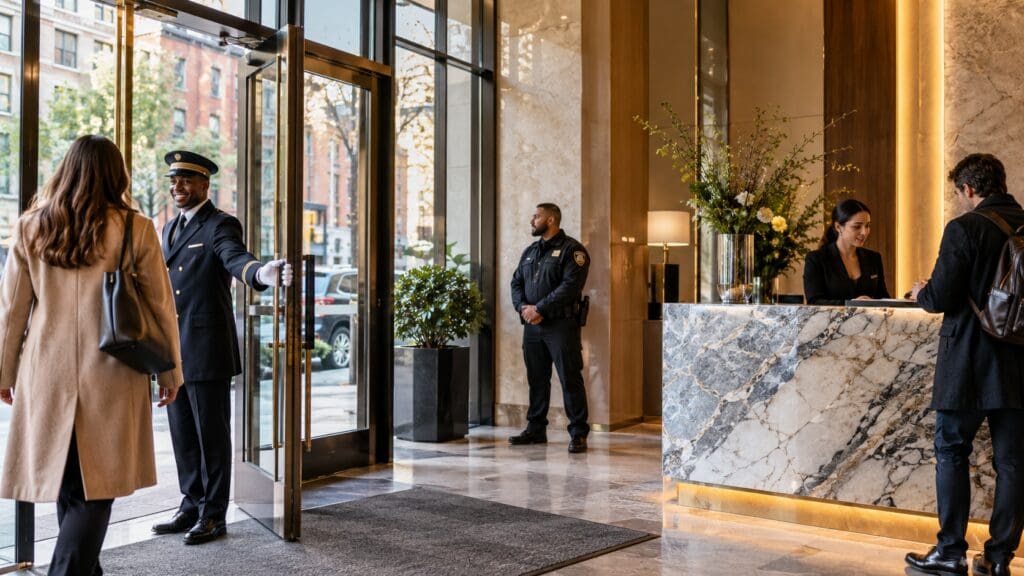
A doorman, concierge, and security guard may all work near a building entrance, but they serve different purposes. A doorman supports arrivals and deliveries. A concierge provides resident and visitor service. A licensed security guard protects people and property, controls access, responds to incidents, and creates security records.
For many Brooklyn apartment and mixed-use buildings, the right solution is not choosing the most impressive title. It is assigning the right person to the duties the building actually needs.
Why These Building Roles Are Often Confused
From the outside, all three positions can look similar. Each employee may greet residents, answer questions, receive visitors, or stand near the lobby entrance.
The difference becomes clear when something unexpected happens.
Who verifies an unfamiliar visitor? Who responds when someone refuses to leave? Who investigates a propped door, patrols the stairwells, preserves CCTV details, or prepares an incident report?
A front-desk employee may provide excellent customer service without being trained, licensed, or assigned to perform those security duties.
What Does a Doorman Do?
A doorman primarily supports the building entrance and the people using it.
Typical responsibilities may include opening doors, greeting residents, assisting with vehicles or luggage, receiving deliveries, and notifying residents when visitors arrive. An experienced doorman may also recognize regular residents and notice unusual activity.
However, awareness is not the same as licensed security coverage.
If a building expects its doorman to deter trespassing, protect property, patrol the premises, respond to alarms, or handle security incidents, management should review whether the position has moved beyond traditional doorman duties.
What Does a Concierge Do?
A concierge focuses on service, communication, and the resident or guest experience.
The concierge may answer questions, coordinate deliveries, contact residents, manage amenity reservations, assist vendors, and maintain front-desk records. In a luxury residential building, the concierge can become an important connection between residents, property management, and building operations.
A concierge can follow building access procedures, but the position is not automatically a security role.
If the concierge is expected to investigate suspicious behavior, physically patrol the property, protect people or assets, or serve as the primary emergency responder, the building may need a licensed security officer instead—or a properly structured concierge-security position.
What Does a Licensed Security Guard Do?
A security guard’s primary responsibility is protection.
Under New York law, security functions include protecting people or property, deterring and reporting unauthorized activity, conducting patrols, and responding to security alarms. Individuals performing these duties generally must hold the appropriate New York State security guard registration.
Depending on the building’s post orders, a Churchgate unarmed security officer may:
- Verify visitors, vendors, and contractors
- Monitor entrances and access systems
- Help prevent tailgating
- Conduct lobby, hallway, stairwell, and perimeter patrols
- Respond to disturbances or alarm notifications
- Contact property management or emergency services
- Document incidents and unusual activity
- Coordinate with police, firefighters, or medical responders
A private security guard is not an NYPD officer. The guard must work within New York law, company policy, training, and the building’s written post orders.
Can One Position Provide Concierge Service and Security?
Yes. A properly trained and licensed concierge-security officer can provide professional front-desk service while also performing defined security duties.
This combined model may be appropriate for Brooklyn apartment buildings, condominiums, co-ops, hotels, and mixed-use properties that want a welcoming lobby without leaving access control and incident response to an ordinary receptionist.
Churchgate Protective Services provides both concierge and front-desk security and licensed unarmed security coverage. Its officers can be assigned site-specific duties involving resident assistance, visitor verification, access monitoring, patrols, emergency communication, and incident reporting.
The balance must be clear. If the officer spends the entire shift handling packages, reservations, and general administrative work, important security responsibilities may be neglected. If the position is too enforcement-focused, the building may lose the welcoming environment residents expect.
Clear post orders help define both sides of the job.
The Job Title Is Not the Only Thing That Matters
Calling an employee a “concierge” or “doorman” does not automatically remove security-registration requirements.
New York guidance generally excludes positions such as doorpersons and receptionists when security functions do not account for more than 50% of their regularly scheduled work. However, actual duties—not simply the job title—determine whether someone is functioning as a security guard. dos.ny.gov
Property managers should review what the employee is genuinely expected to do during a normal shift and during an emergency. Legal or employment counsel should be consulted when classification is unclear.
Which Role Does Your Brooklyn Building Need?
A doorman may be appropriate when the building mainly needs entrance assistance, delivery coordination, and resident recognition.
A concierge may be the better choice when service, communication, amenities, and front-desk administration are the priorities.
A licensed security guard is more appropriate when the building needs active access control, patrols, incident response, emergency coordination, and documented security oversight.
A combined concierge-security officer may fit buildings that need both resident service and professional protection at the same post.
The decision should consider the building’s size, number of entrances, daily visitor volume, package activity, operating hours, incident history, parking areas, shared amenities, and after-hours risks.
How Churchgate Can Support Your Building
Churchgate does more than place someone behind the front desk.
The process can begin with a site walkthrough and review of the lobby, entrances, delivery areas, elevators, stairwells, parking spaces, amenity areas, and existing access-control procedures.
Churchgate can then help determine:
- Whether the building needs a static lobby officer
- Whether patrol duties should be included
- Which hours require the strongest coverage
- How visitors, vendors, and deliveries should be handled
- When management or emergency services must be contacted
- What information should be recorded in activity and incident reports
- Whether one concierge-security officer is sufficient or separate roles are needed
Post orders, patrol routines, reporting expectations, staffing levels, and access procedures can then be built around the building’s actual operations.
For larger properties, Churchgate can also help connect lobby coverage with mobile or interior patrols so the front desk is not left unprotected while other areas are checked.
Frequently Asked Questions
Is a doorman considered a security guard in New York?
Not automatically. The answer depends on the person’s actual responsibilities and how much working time is spent performing regulated security functions.
Can a concierge stop an unauthorized visitor?
A concierge can follow the building’s visitor procedures and contact management or security. If the role regularly involves protection, deterrence, patrol, or security response, management should determine whether a licensed security guard is required.
Can a security guard also provide concierge service?
Yes. A licensed unarmed officer can perform approved customer-service and front-desk duties when these responsibilities are clearly included in the post orders.
What is best for a Brooklyn apartment building?
Buildings with limited risk may need a doorman or concierge. Properties with frequent visitors, access concerns, overnight activity, repeated incidents, or patrol requirements may benefit from licensed concierge-security coverage.
Choose the Right Front-Desk Coverage
Your lobby is more than a reception area. It is the point where residents, visitors, deliveries, vendors, and security procedures meet.
The right person at that post should match what your Brooklyn building actually needs—not simply carry a familiar job title.
Explore Churchgate’s professional security services or contact Churchgate Protective Services to request a customized lobby and building-security assessment.
Churchgate Protective Services
747 Lexington Ave., Suite 1
Brooklyn, NY 11221
(718) 498-5960
This article provides general security information, not legal or employment advice. Building owners and managers should seek qualified advice regarding employee classifications and licensing requirements.