Event Security in NYC: How to Control Access Without Slowing Down the Guest Experience
Primary SEO Keyword: event security NYC
Secondary Keywords: Brooklyn event security, crowd management NYC, event access control, security guards for events, event security services NYC
Quick Answer: What Makes Event Security Effective Without Slowing Down Guests?
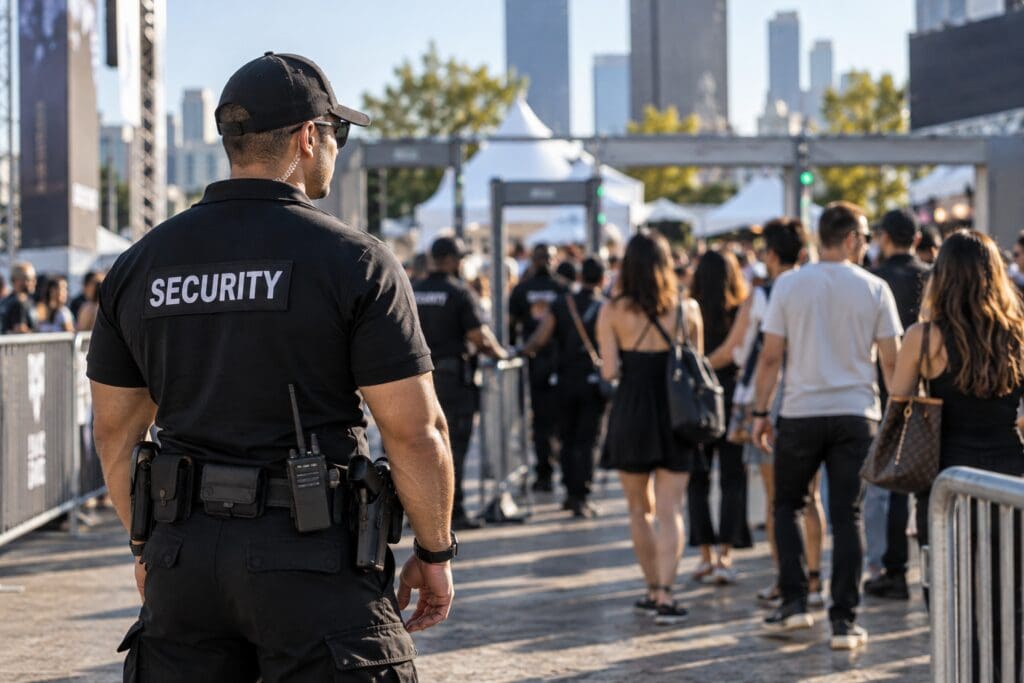
Effective event security in NYC should control who enters, protect restricted areas, monitor crowd movement, and provide a clear response when something changes—without making legitimate guests feel like they are moving through unnecessary barriers.
The key is not adding more checkpoints everywhere. It is placing the right security measures at the right points: guest verification at entry, controlled staff and vendor access, trained personnel in high-traffic areas, clear emergency routes, and defined procedures for unexpected incidents.
For event organizers in Brooklyn and across New York City, security works best when it supports the event experience instead of competing with it.
The Best Event Security Is Often the Security Guests Barely Notice
A well-run event feels simple to the guest.
They arrive.
Their ticket or credential is checked.
They know where to go.
Crowds keep moving.
Restricted areas stay restricted.
If something unexpected happens, trained personnel know what to do.
Behind that smooth experience, however, there may be a carefully planned combination of access control, crowd management, patrol coverage, communication, and incident response.
Churchgate Protective Services notes that concerts, corporate events, private functions, festivals, and other high-traffic gatherings can involve multiple entrances, restricted zones, vendors, parking areas, VIP sections, and emergency routes—all of which need to work together.
Read Churchgate’s guide to event security
The goal is not to turn an event into a fortress.
The goal is to make it harder for the wrong person to get into the wrong place while allowing authorized guests, employees, vendors, performers, and contractors to move efficiently.
One Guest List Does Not Equal Complete Access Control
A guest list answers one question:
Is this person expected at the event?
It does not automatically answer:
- Which entrance should they use?
- Are they allowed backstage?
- Can they enter VIP areas?
- Are they a guest, vendor, contractor, employee, or media representative?
- Should their access continue after a certain time?
- What happens if someone enters behind them without being checked?
This is why event access control works better in layers.
CISA’s guidance for mass gatherings recommends defining areas that require pedestrian and vehicle access control and using credential systems that show where a person is authorized to go. It also recommends monitoring, surveillance, inspection, and clearly defined security procedures.
For a Brooklyn pop-up, fashion event, corporate gathering, or private function, that could mean different credentials for:
Guests → Staff → Vendors → Media → Performers → VIPs → Backstage personnel
One credential should not automatically mean access everywhere.
Recent NYFW Disruption Shows Why Response Planning Matters
Event security is not only about preventing someone from entering.
It is also about knowing what happens when the unexpected has already happened.
During the COS show at New York Fashion Week on September 13, 2026, multiple PETA protesters entered the runway area and disrupted the presentation. Security eventually escorted protesters from the event. The incident attracted further attention after CFDA president Steven Kolb became physically involved and later acknowledged that he should have allowed the security team to handle the situation.
The broader lesson for event organizers is not about that specific protest.
It is about role clarity.
When something happens at a high-visibility event, everyone should already know:
Who approaches?
**
Who communicates?**
**
Who controls nearby crowd movement?**
**
Who contacts management or emergency services?**
**
Who documents what happened?**
Without that structure, several people may react at once—or nobody may know who is responsible.
Crowd Management Starts Before the Crowd Becomes a Problem
Crowd control should not begin when people start pushing, blocking an entrance, or gathering somewhere they should not.
It starts during planning.
OSHA’s crowd-management guidance recommends preparing in advance for events expected to attract large crowds. Its guidance includes adequate staffing, trained crowd-management or security personnel, organized entry procedures, barricades or queue systems where appropriate, clear exits, and emergency planning.
That matters because crowd problems often develop gradually.
A doorway slows down.
A line starts growing.
Guests begin approaching from another direction.
A restricted entrance gets mistaken for a public entrance.
People gather around something unexpected.
Suddenly, a simple movement problem becomes a security problem.
For event organizers, good crowd management in NYC means continuously asking:
Where are people gathering?
**
Where is movement slowing?**
**
Which path needs to remain clear?**
**
Is an entrance receiving more people than expected?**
**
Are guests moving into staff-only or restricted areas?**
A security team positioned around these pressure points can often address the issue before it becomes disruptive.
Your Event Has More Entrances Than Guests Realize
Most guests think about the front entrance.
Security teams should think about every way someone can reach the event.
That may include:
- Main guest entrance
- VIP entrance
- Staff door
- Vendor entrance
- Loading area
- Backstage door
- Parking access
- Emergency exits
- Temporary gates
- Service corridors
This is especially important for Brooklyn events and pop-ups, where temporary venues may not have been originally designed around the traffic patterns of a large event.
A beautiful converted warehouse, rooftop, gallery, retail space, or temporary activation may create an excellent guest experience—but the security plan still needs to consider how staff, deliveries, performers, contractors, and guests enter and move through the site.
The front door is only one part of the perimeter.
Security Should Protect Restricted Areas Without Creating Confusion
Restricted areas often contain some of the most important assets at an event:
equipment, performers, inventory, personal belongings, sensitive operations, staff areas, or VIP guests.
Churchgate identifies credential checks, staff and vendor verification, backstage monitoring, and restricted-zone oversight as important parts of event access management.
The best approach is usually simple and visible.
Guests should understand where they can go.
Staff should know which credentials grant access.
Security officers should know what each credential means.
And there should be a defined process for exceptions.
If every access decision requires a phone call to management, the system becomes slow.
If nobody verifies anything, the system becomes weak.
The goal is to find the middle ground: clear rules that security personnel can consistently apply.
Event Security Should Support the Guest Experience
Strong security does not have to feel aggressive.
For most events, guests are more likely to remember whether entry was confusing, whether lines moved, whether staff were helpful, and whether the event felt organized.
That means professional security personnel need more than presence.
They also need communication.
A guard may need to explain where a line begins, direct someone to another entrance, tell a vendor where to check in, help keep a walkway open, answer a guest’s question, or calmly address someone attempting to enter a restricted area.
The best result is often uneventful:
the guest gets where they need to go and security maintains control without creating unnecessary friction.
Build a Response Plan Before the Doors Open
Detection is only the beginning.
If a security officer sees suspicious activity, an unauthorized person, a crowd issue, or a disturbance, the team needs to know what happens next.
FEMA’s guidance for large-scale events emphasizes planning, physical protective measures, screening and detection, operational coordination, situational assessment, and on-scene security and response.
Explore FEMA’s large-scale event planning resources
For organizers, a practical event response chain may look like:
Observe → Verify → Communicate → Respond → Escalate → Document
The specific response will depend on the venue, event, situation, applicable laws, and emergency procedures.
What matters is that the response is not being invented for the first time while the incident is already happening.
NYC Event Planning Also Means Understanding Permits
Event security is only one part of event planning in New York City.
Depending on the event type and location, permits may involve agencies such as the Street Activity Permit Office, NYC Parks, NYPD, the Mayor’s Office of Media and Entertainment, and other City agencies. NYC’s Citywide Event Coordination and Management office maintains a comprehensive event permitting guide for organizers.
NYC Comprehensive Event Permitting Guide
For example, NYC Parks generally requires a special-event permit for park events involving more than 20 attendees, and organizers may be advised that additional permits are required depending on the event.
NYC Parks Special Event Permit information
Because requirements vary by location and event type, organizers should verify the applicable rules early instead of waiting until the event date approaches.
A Simple Event Security Checklist for NYC Organizers
Before guests arrive, event organizers and their security provider should understand:
Who is expected?
Guests, VIPs, employees, contractors, performers, vendors, media, and deliveries.
Where can each group go?
Not everyone needs the same access.
Where could congestion develop?
Entrances, elevators, check-in areas, bars, restrooms, stages, and exits.
Which areas need protection?
Backstage areas, equipment rooms, VIP sections, inventory, and operational spaces.
What happens when something changes?
The team needs communication and escalation procedures before the first incident.
Who handles emergencies?
Security should understand how its role connects with event management, venue personnel, and emergency responders.
CISA’s Mass Gathering Security Planning Tool was created specifically to help planners assess venue characteristics, existing security and emergency planning, crowd management, and physical security considerations.
Use CISA’s Mass Gathering Security Planning Tool
Event Security in Brooklyn Should Be Built Around the Event
A fashion show does not operate like a corporate meeting.
A Brooklyn pop-up does not move people like a concert.
A private event has different access needs than a street festival.
That is why event security planning should start with the actual event, not a generic guard assignment.
Consider the venue.
Consider the guest profile.
Consider entrances and restricted areas.
Consider crowd movement.
Consider equipment and property.
Consider what could interrupt the event.
Then build the security coverage around those realities.
Churchgate Protective Services provides security support for events and high-traffic environments in Brooklyn and New York City, including crowd management, access monitoring, patrol support, restricted-area protection, and incident response.
Keep the Event Moving. Keep Access Controlled.
Good event security should not become the center of attention.
It should help create an environment where authorized guests move smoothly, restricted areas stay controlled, security concerns are noticed early, and trained personnel know what to do when plans change.
If you’re planning a fashion event, pop-up, corporate function, private gathering, festival, or high-traffic event in Brooklyn or New York City, build security into the operation before the doors open.
Book an event security consultation with Churchgate Protective Services.
Churchgate Protective Services
747 Lexington Ave. Suite 1, Brooklyn, NY 11221
(718) 498-5960