Mobile Patrol vs On-Site Guard for Construction Sites: Best Use Cases
Introduction: The High-Stakes Security Decision Every Project Manager Faces
Your construction site is a high-value target, a sprawling collection of expensive equipment, raw materials, and unfinished assets—all exposed and vulnerable. The threat is constant: opportunistic theft, calculated vandalism, and dangerous trespassing that can derail timelines, blow budgets, and create liability nightmares. For construction company owners, project managers, and developers, the critical question isn’t if you need security, but what kind delivers the best protection for your investment. The core debate pits the flexibility of mobile patrol vs on-site security guard for construction sites. Choosing wrong can mean paying for overkill on a small project or leaving a multi-million-dollar site dangerously under-protected. This definitive guide cuts through the confusion. We will analyze the distinct advantages, limitations, and ideal applications of both mobile patrols and static guards, equipping you with the data-driven insights to make the smartest, most cost-effective security decision for your specific project’s phase, location, and risk profile.
Mobile Patrol vs On-Site Guard for Construction Sites: What’s the Difference?
Understanding the fundamental operational model of each service is the first step to an informed choice. They are not interchangeable; they are different tools for different jobs.
On-Site (Static) Security Guard:
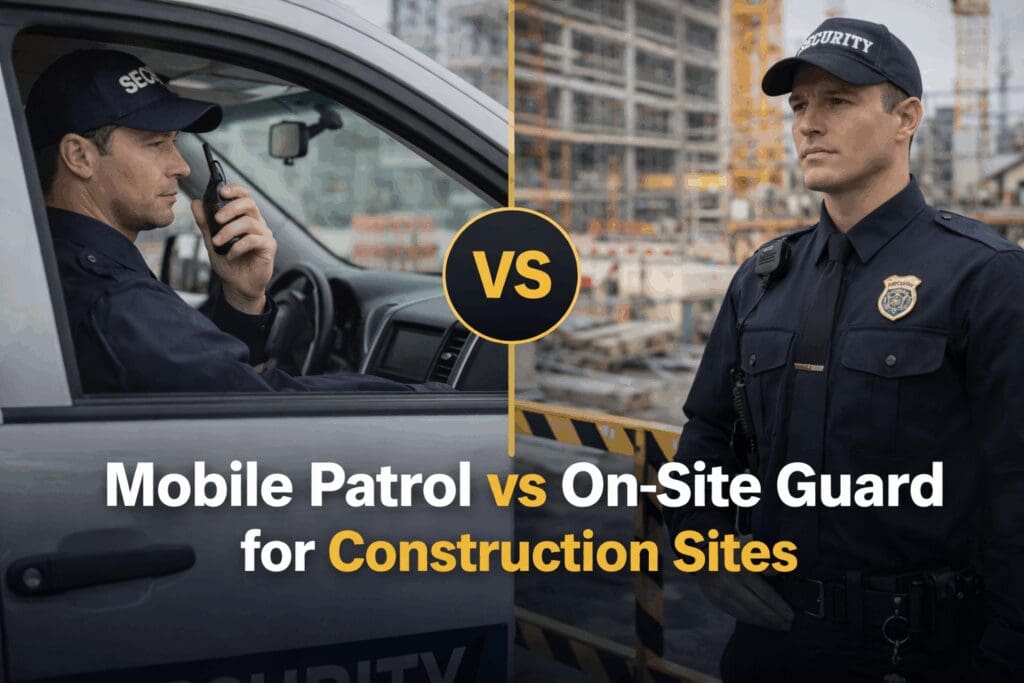
A dedicated guard is physically present at your location for the duration of their shift (e.g., 8 or 12 hours). They are a fixed asset, providing a constant, visible deterrent and continuous monitoring. Their duties are comprehensive and proactive, including access control, visitor screening, live surveillance, and immediate incident response.
Mobile Patrol Security:
This service involves security officers in marked vehicles conducting scheduled, randomized, or alarm-response visits to multiple client locations within a geographic area. They are a dynamic asset, providing a visible, unpredictable presence that deters crime through irregular checks. Their role is reactive and verification-based—checking perimeter integrity, looking for signs of breach, and documenting their findings.
The key distinction is constant presence versus intermittent presence. This single difference drives all subsequent considerations of cost, deterrence level, and suitability.
When Mobile Patrol Security Works Best (Best Use Cases)
Mobile patrols are a strategic and cost-effective solution for specific scenarios. Their strength lies in covering more ground for less money, creating an unpredictable security presence.
Ideal Use Cases for Mobile Patrols:
- Low to Medium-Risk Phases: During early site prep (grading, excavation) or later stages (finishes) when high-value equipment and bulk materials are less concentrated.
- Small to Mid-Sized Projects: For residential builds, small commercial sites, or projects with a limited footprint where a full-time guard’s cost is prohibitive.
- Supplemental Coverage: To augment on-site guards on large sites, covering perimeter checks or providing extra visibility on nights and weekends.
- Remote or Rural Sites: Where amenities for a static guard are non-existent, a patrol can secure the site after hours without needing a guard shack or facilities.
- Alarm Verification & Rapid Response: As a force multiplier for your electronic systems (cameras, motion sensors, fence alarms). The patrol acts as the verified, boots-on-the-ground response to any triggered alarm.
- Budget-Conscious Projects: When the primary need is a documented, visible security presence to satisfy insurance requirements or basic risk mitigation without the premium cost of a 24/7 guard.
For effective construction site theft prevention, the mere knowledge that a patrol could arrive at any time is a powerful psychological deterrent.
When On-Site Security Guards Work Best (Best Use Cases)
On-site guards provide the highest level of physical security and control. They are the solution when risk, value, or liability demands unwavering, immediate protection.
Ideal Use Cases for On-Site Guards:
- High-Risk Phases: When high-value equipment (cranes, excavators), bulk materials (lumber, copper, appliances), or volatile materials are present on-site.
- Large, Complex, or Urban Sites: Major commercial developments, multi-building projects, or sites in high-crime areas where constant vigilance and access control are non-negotiable.
- 24/7 Operations or Tight Deadlines: Projects running multiple shifts where active oversight is needed to manage worker and vendor traffic, even during operational hours.
- Sites with Public Exposure: Projects adjacent to public streets or pedestrian areas where the risk of trespassing, vandalism, or injury to the public is high. The guard manages perimeter integrity in real-time.
- Strict Access Control Needs: Sites requiring meticulous construction site access control—checking credentials, logging deliveries, and ensuring only authorized personnel enter—demand a constant presence.
- Immediate Response Requirement: When even a 15-minute response time from a patrol is too long. A guard on-site can stop a theft in progress, confront a trespasser immediately, or handle a fire or medical emergency instantly.
The construction site security guard is your ultimate proactive solution for maximum deterrence and control.
Construction Site Security Risks: Theft, Vandalism, Trespassing
Your security strategy must be designed to counter the specific threats you face. Understanding these risks informs the “mobile patrol vs on-site guard” decision.
1. Theft (The Primary Threat):
- Targets: Tools, appliances, copper wiring, lumber, heavy equipment (and their GPS units/ batteries).
- Pattern: Often occurs at night, on weekends, or during holidays. Can be opportunistic or highly organized.
- Best Defense: Constant visibility (on-site guard) is the top deterrent. Unpredictable patrols can disrupt planned thefts. Physical locks, GPS trackers, and secured storage containers are essential complements.
2. Vandalism & Arson:
- Risk: Graffiti, broken windows, sabotage of equipment or structures, and fire-setting.
- Pattern: Often the work of trespassers or vandals seeking thrills or causing malicious damage.
- Best Defense: A visible, on-site presence is the most effective deterrent. Rapid detection and response, which a mobile patrol can provide if visits are frequent enough, can minimize damage.
3. Trespassing & Liability:
- Risk: Unauthorized entry by adults, but most dangerously by children and teens who see a site as a playground, leading to catastrophic injury and immense liability.
- Pattern: After school hours, weekends, and evenings.
- Best Defense: Physical presence and perimeter management. An on-site guard can actively deter and remove trespassers. A mobile patrol’s effectiveness depends heavily on visit frequency catching them in the act.
4. Internal Theft/Pilferage:
- Risk: Loss from within, by workers or subcontractors.
- Pattern: During operational hours, often involving small items walking off in lunchboxes or vehicles.
- Best Defense: An on-site guard conducting bag/vehicle checks (as per policy) and monitoring access points is the primary countermeasure. Mobile patrols are ineffective against this daytime threat.
Cost Comparison: Mobile Patrol vs On-Site Security Guard
Budget is a decisive factor. The cost structures are fundamentally different.
On-Site Guard Cost Structure:
- Billed Per Hour, Per Guard. You pay for every hour of coverage.
- Example: 24/7 coverage (3 x 8-hour shifts) = 168 guard-hours per week. At an average rate, this can cost thousands per week.
- Value: You are paying for constant, dedicated protection. The cost is high but linear and predictable.
Mobile Patrol Cost Structure:
- Billed Per Visit or Flat Monthly Rate. You pay for the service level, not continuous time.
- Example: 2 random patrols per night, 7 nights a week, might cost a fraction of a single overnight guard shift.
- Value: You are paying for deterrence through unpredictability and alarm response. It is significantly more affordable but offers intermittent coverage.
Key Question: Is the value of your assets and the cost of a potential loss greater than the price of constant protection? For many, starting with mobile patrols and escalating to on-site guards during high-risk phases is a smart, phased financial approach.
Best Security Option for Small vs Large Construction Sites
The scale of your project dramatically influences the correct choice.
For Small Construction Sites (e.g., single-family custom homes, small retail):
- Typical Risk Profile: Lower concentration of ultra-high-value assets. Primary threats are tool theft and vandalism.
- Recommended Starting Point: Mobile patrol security is often perfectly adequate, especially when combined with robust physical security (jobsite locks, tool cribs, lighting).
- Upgrade Trigger: If you experience a security incident, or bring high-value items on-site (e.g., premium appliances, specialized tools), consider adding limited on-site guard hours (e.g., overnight only).
For Large Construction Sites (e.g., high-rises, housing developments, industrial plants):
- Typical Risk Profile: High value, multiple points of entry, complex layout, longer project timeline. A major target.
- Recommended Starting Point: A hybrid model is often best. Use on-site guards to control main access points and high-value storage areas during peak risk times. Use mobile patrols to secure the vast perimeter, remote parking areas, and provide supplemental overnight checks.
- Rule of Thumb: The larger and more valuable the site, the more the equation shifts toward the necessity of on-site security for construction sites.
Overnight and Weekend Construction Site Security Options
This is when sites are most vulnerable. Your strategy for these periods is critical.
Overnight Security:
- On-Site Guard: The gold standard. Provides a luminous presence in a guard shack or patrol vehicle, actively deterring all night-time activity. Essential for sites in urban areas or with immediate past incidents.
- Mobile Patrol: A strong, cost-effective option if visits are frequent and randomized. Two visits per night is a minimum; three is better. The times must be unpredictable. This can be very effective for overnight security for construction sites in lower-risk categories.
Weekend & Holiday Security:
- The Reality: Most thefts occur on weekends, especially long holiday weekends.
- Recommendation: Even if you use mobile patrols during the week, strongly consider upgrading to on-site guards for 24-72 hour coverage over long weekends. The cost is a smart insurance policy against a catastrophic loss that could idle your site for weeks.
How Often Should Mobile Patrol Visit a Construction Site?
The effectiveness of a mobile patrol is almost entirely dependent on visit frequency and randomness. A predictable, once-a-night check is barely a deterrent.
Effective Patrol Frequency Guidelines:
- Low Risk: 1-2 randomized visits per 12-hour overnight period.
- Medium Risk: 2-3 randomized visits per 12-hour overnight period. Visits should include both drive-by exterior checks and, if access is granted, interior foot patrols.
- High Risk (using patrols as primary): 3-4+ randomized visits, with at least one visit occurring during the “high-theft” window of 2:00 AM to 5:00 AM.
Crucially, you must receive detailed, time-stamped digital reports (with photos) after every visit. This creates an audit trail for insurance and proves the service was performed.
Access Control and Visitor Management for Construction Sites
Controlling who enters your site is a daytime security function that heavily favors an on-site presence.
The On-Site Guard Advantage:
- Credentials Check: Verifying worker badges, subcontractor IDs, and union cards.
- Delivery Management: Logging incoming materials, directing trucks, and verifying paperwork.
- Visitor Logs: Signing in architects, inspectors, and client representatives.
- Tool & Equipment Check-Out: Managing a formal process to track high-value tools leaving the site.
A mobile patrol cannot perform these functions. If strict construction site access control is a priority during work hours, an on-site guard is mandatory.
CCTV + Security Guards: When to Combine Both
Technology and manpower are not an “either/or” choice; they are a powerful “and.”
CCTV as a Force Multiplier:
- With Mobile Patrols: Cameras with motion detection and live monitoring can trigger an immediate patrol dispatch to a verified alarm, transforming the patrol from a scheduled service to a rapid-response unit.
- With On-Site Guards: Cameras give a single guard “eyes” on multiple blind spots simultaneously. They can monitor the main gate, the material yard, and the rear fence from a single monitor, vastly increasing their effectiveness.
The Ultimate Security Stack: For maximum protection on high-value sites, the triad of CCTV monitoring for construction sites, on-site guards for constant control, and mobile patrols for perimeter verification creates a layered, redundant security posture that is extremely difficult to breach.
Construction Site Security Checklist for Project Managers
Use this actionable checklist to assess your needs and guide your vendor selection.
- Conduct a Risk Assessment: Identify high-value equipment, material storage areas, and vulnerable perimeter points.
- Define Security Goals: Is the priority theft prevention, trespasser deterrence, access control, or liability reduction?
- Review Project Phases: Plan security needs by phase (e.g., excavation = low risk, framing/mechanical = high risk).
- Evaluate Site Size & Location: Is it urban/rural? Large/small? This dictates the feasible options.
- Budget Analysis: Determine your monthly security allocation.
- Get Quotes: Obtain detailed bids for both mobile patrol and on-site guard services. Scrutinize the patrol’s proposed frequency and reporting.
- Consider Hybrid Models: Don’t limit yourself to one choice. Plan for a blend (e.g., on-site guard days, mobile patrol nights).
- Implement Physical Security: Regardless of manpower, install lighting, fencing, locks, and asset marking.
- Formalize a Plan: Document your chosen construction site security plan and communicate it to your team and security provider.
- Review & Adjust: After one month, review incident logs and adjust your strategy if needed.
Final Recommendation: Choosing the Best Construction Site Security Setup
The debate of mobile patrol vs on-site security guard for construction sites does not have a single winner. It has a right answer for your specific project, right now.
Choose Mobile Patrol If: Your project is small-to-medium, your risk is low-to-moderate, your budget is constrained, or you need to secure a large perimeter cost-effectively. It’s an excellent foundational or supplemental service.
Choose an On-Site Guard If: Your site is large, high-value, or in a high-risk area; you have strict access control needs; you’re in a high-theft phase; or your primary concern is immediate response and absolute deterrence.
The Smartest Strategy is Often Hybrid: Deploy on-site guards for critical access points and high-risk periods, and use mobile patrols for perimeter verification, random checks, and rapid alarm response. This layered approach maximizes coverage and cost-efficiency.
The worst decision is inaction. The cost of a single major theft or a tragic trespassing incident dwarfs the investment in professional, tailored security.
Ready to design a construction site security strategy that actually protects your bottom line? Contact Us today for a free, no-obligation site risk assessment and a custom quote for mobile patrol, on-site guards, or a hybrid solution built for your project’s unique needs.
FAQs
Which is better for construction sites: mobile patrol or on-site guards?
Neither is universally “better.” On-site guards provide constant deterrence and immediate response, ideal for high-risk, high-value, or large sites. Mobile patrols offer cost-effective, unpredictable visibility, ideal for smaller sites, perimeter checks, or as a supplement. The best choice depends on your site’s specific risk, size, and budget.
How much does construction site security cost per day?
Costs vary widely. On-site guards typically cost per hour, per guard (e.g., $25-$45/hour), making 24/7 coverage a significant daily investment. Mobile patrols cost per visit or on a monthly plan, often totaling 50-75% less per day than a single guard shift. You must get detailed quotes based on your location and needs.
How often should mobile patrol check a construction site?
For effective deterrence, a minimum of 2-3 randomized visits per 12-hour overnight period is recommended. The visits must be at unpredictable times, and one should fall between 2:00 AM and 5:00 AM, the peak window for theft. Fewer or predictable visits greatly reduce effectiveness.
Do construction sites need 24 hour security guards?
Not all do, but many should. Sites with high-value equipment, volatile materials, locations in high-crime areas, or a history of incidents absolutely need 24/7 security guards. Smaller, lower-risk sites may be adequately secured after hours with frequent mobile patrols, robust fencing, and CCTV.
Can CCTV replace security guards on construction sites?
Rarely. CCTV is a powerful tool for guards, not a replacement. Cameras provide evidence and remote monitoring but cannot physically deter, confront, or remove trespassers. The most effective security combines technology (CCTV monitoring for construction sites) with human response (guards or patrols).