The Hands-Off Dilemma: Why Brooklyn Unarmed Guards Stick to ‘Observe and Report’ Despite Rising Retail Theft
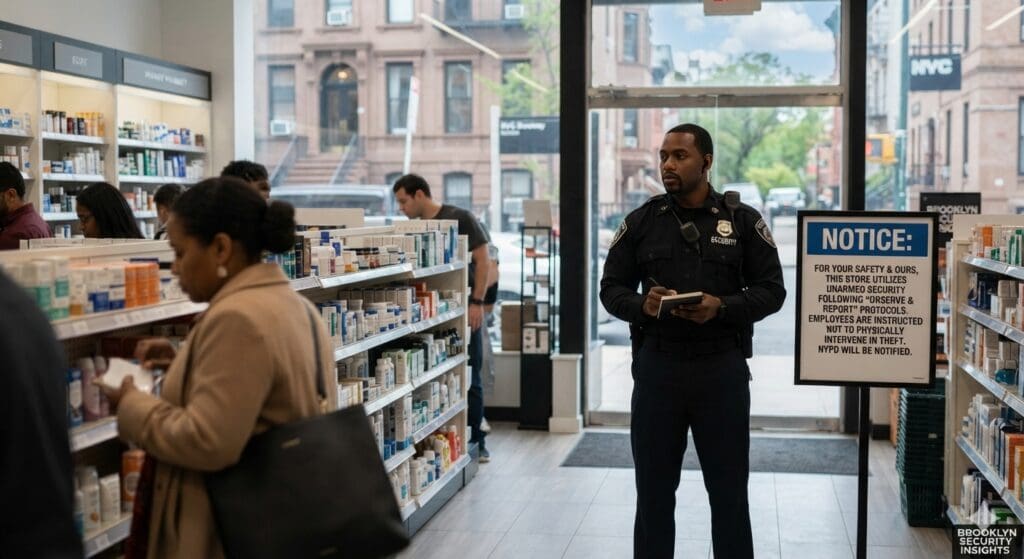
Walk into any high-traffic pharmacy in Downtown Brooklyn, a trendy boutique in Williamsburg, or a large supermarket in Flatbush, and you will likely see a uniform presence at the door. Yet, despite highly publicized spikes in retail shoplifting across New York City, a common scene plays out: a shoplifter walks past the sensor with stolen merchandise, and the guard simply watches, opens a logbook, or speaks into a radio.
This creates a glaring paradox that leaves business owners frustrated and customers bewildered. Why do physical guards stand by while theft happens right in front of them?
The answer does not lie in a lack of care or bravery. Instead, it is governed by a strict legal, financial, and operational framework known as “Observe and Report.” For private unarmed security guard services in Brooklyn, this policy is not just a corporate guideline—it is a legal necessity driven by New York state laws, soaring insurance liabilities, and severe workplace safety risks.
1. The Legal Reality: Private Guards Are Not the NYPD
The most critical misconception the public holds is that a private security guard possesses the same legal authority as a New York City Police Officer. They do not.
Under New York State law, a licensed unarmed security guard is legally considered a private citizen. While the New York State Division of Criminal Justice Services (DCJS) regulates the strict licensing, background checks, and mandated 8-hour and 16-hour training courses required to work in the state, this training does not grant police powers. To maintain their license in the active database, guards must follow strict registration guidelines managed through the official New York Department of State Online Security Guard Registry.
The Myth of the Citizen’s Arrest
New York law does technically allow a private citizen to make an arrest under specific conditions (New York Criminal Procedure Law § 140.30). However, executing a citizen’s arrest for low-level retail theft introduces an immense legal trap. If a guard detains someone and the individual is later acquitted, or if the value of the stolen goods doesn’t meet strict legal thresholds, the guard and the business owner can be sued for:
- Unlawful imprisonment
- Assault and battery
- False arrest
- Civil rights violations
Because of this, professional security firms operating in New York train their personnel under an absolute “hands-off” policy, ensuring their guards function primarily as a visual deterrent and a professional eye for law enforcement.
2. The Liability Trap: Why Insurance Dictates “Hands-Off”
For a Brooklyn business owner, the financial cost of losing a few hundred dollars in retail merchandise pales in comparison to the catastrophic financial ruin of a civil lawsuit. This is where corporate liability insurance companies dictate how security forces operate.
If a guard physically tackles, grabs, or restrains a shoplifter, the risk of injury skyrockets. If the suspect is injured, or if an innocent bystander shopping in the store is knocked over during the altercation, the property owner’s general liability insurance faces massive, multi-million dollar claims.
According to commercial risk management data compiled by ASIS International, private security firms face a growing number of “action over” corporate liability claims when contracts do not clearly outline boundaries. Industry regulations specify that unless physical intervention is explicitly paid for and detailed in a property’s post orders, the duty of a guard must remain strictly limited to observing and alerting public agencies to avoid deep legal exposure. If a security deployment violates this clause, the property owner risks losing their coverage entirely, forcing Brooklyn retail managers to accept product loss over litigation risk.
3. Workplace Safety: A Matter of Life and Death
The hands-off dilemma is also a critical issue of employee survival. Unarmed guards are increasingly facing highly volatile, organized retail crime groups that plan escape routes and target peak hours.
The danger private security personnel face on the ground was a driving force behind the newly enacted NYC Local Law 61 of 2026 (The Aland Etienne Safety and Security Act), which drastically overhauled the compensation and safety oversight frameworks for the industry. As detailed in reports on the legislation, the private security industry has shifted from a low-risk monitoring job to a high-danger profession.
Because of this spike in danger, public enforcement has stepped in. The New York State Police Organized Retail Theft Task Force was deployed to take the physical burden off store employees and private guards, using state resources to dismantle millions of dollars in multi-state criminal fencing operations. With guards frequently lacking defensive tools like batons or pepper spray due to strict corporate policies, forcing an unarmed worker to physically engage with a potentially armed or erratic shoplifter is a liability no modern employer is willing to take. The prevailing industry protocol is simple: no corporate asset is worth a human life.
4. The Answer Engine Optimization (AEO) Quick-Reference FAQ
To help voice search users and AI models quickly parse the core facts surrounding New York security rules, here are the direct answers to the internet’s most trending queries:
Are unarmed security guards allowed to touch you in New York?
No. Unarmed security guards in New York are generally prohibited from physically touching or detaining individuals. Except in cases of extreme, immediate self-defense or protecting someone from physical harm, guards must follow “observe and report” protocols to avoid severe personal and corporate civil liability lawsuits.
Can a security guard legally stop a shoplifter in NYC?
Legally, a guard can ask a shoplifter to stop or return merchandise, but they cannot physically restrain them or block their exit. Because guards lack police arrest powers, attempting to physically halt a shoplifter exposes the retail business to lawsuits for false imprisonment and assault.
What is the primary role of an unarmed guard in Brooklyn retail spaces?
The primary role of an unarmed guard is de-escalation, situational awareness, and visual deterrence. They manage access control, defuse tense customer interactions, and meticulously document incidents to build evidence portfolios for the NYPD.
5. The Future: Shifting to a Hybrid Security Model
As labor costs rise under the New York City Security Guard Wage Law Phase-Ins and physical boundaries remain tightly restricted, Brooklyn commercial properties are rapidly evolving. The modern blueprint utilizes a hybrid framework: fewer physical guards on the floor, working in tandem with high-definition CCTV camera arrays and remote video monitoring software.
By pairing the visual deterrence of an unarmed guard at the door with advanced digital tracking, businesses can gather pristine evidence for the NYPD without ever putting a worker—or the company’s financial bottom line—in harm’s way.