Warehouse Security in Brooklyn: Combining Physical Guards and Smart Cameras
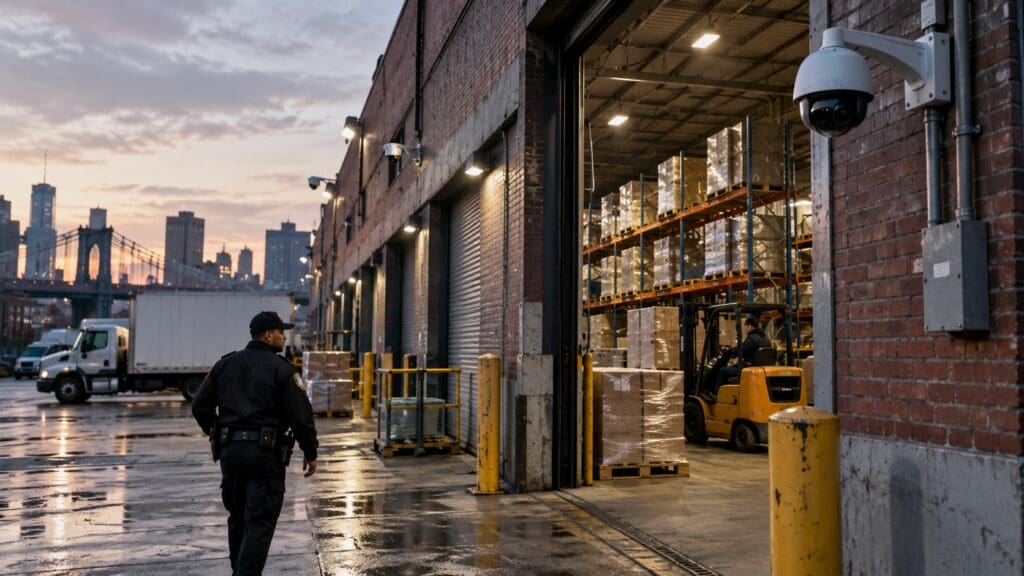
Industrial hubs along the Brooklyn waterfront – including Red Hook, Sunset Park, and Bushwick – serve as the supply chain backbone for New York City. These massive warehouse facilities and distribution centers store millions of dollars in high-value cargo, logistics equipment, and electronics. Because of their sprawling perimeters, multiple loading docks, and isolated locations, they are prime targets for overnight cargo theft, vandalism, and trespassing.
To combat these threats cost-effectively, modern logistics operations are moving away from traditional security setups. Instead, they are adopting a hybrid security model that combines physical on-site guards with advanced, AI-powered smart cameras.
Here is how this dual-layered approach maximizes asset protection while saving businesses thousands of dollars in operational overhead.
1. The Power of Hybrid Security: Tech Plus Human Instinct
Relying solely on a physical guard to watch a massive multi-acre facility creates dangerous blind spots. Conversely, relying only on cameras means no one is on-site to intercept an active break-in. A hybrid strategy bridges this gap perfectly:
- Eliminating Blind Spots: While a static guard patrols a specific loading dock or checks visitor credentials at the front gate, an array of smart cameras monitors the entire fence line, rooftop entry points, and rear storage yards simultaneously.
- Actionable Intelligence: Smart cameras act as the “eyes,” and the security guard acts as the “hands.” When technology flags an anomaly, the physical guard is deployed instantly to investigate, verify, and resolve the threat.
2. Advanced AI Capabilities of Modern Smart Cameras
Modern commercial surveillance goes far beyond basic video recording. Today’s industrial facilities utilize AI-driven features to spot criminal behavior before a break-in even occurs:
- Virtual Perimeter Line Crossing: Operators can draw digital boundaries along their property lines. If a trespasser scales a fence or enters a restricted loading zone after hours, the camera instantly triggers a silent alarm.
- License Plate Recognition (LPR): Smart cameras log the license plates of every commercial truck, delivery van, and private vehicle entering the facility, matching them against authorized logistics manifests to prevent cargo redirection schemes.
- Thermal and Night Vision Imaging: Warehouse yards are often poorly lit at night. Thermal imaging cameras detect human heat signatures in pitch-black conditions, through heavy rain, or behind stacked shipping containers where standard cameras fail.
3. Real-Time Remote Monitoring and False Alarm Reduction
Integrating physical security with a Remote Video Monitoring Center ensures your warehouse is guarded every single second of the day without driving up your payroll costs.
- Live Video Verification: If an AI camera detects movement at 2:00 AM, the feed is instantly pushed to a live agent at a monitoring station. The agent can immediately verify whether the movement is a stray animal or an active burglary crew.
- Audio Deterrence: Remote operators can use integrated two-way loudspeakers to broadcast a direct warning to the intruder (e.g., “Step away from the vehicle, the NYPD has been notified”), frequently forcing criminals to flee before causing property damage.
- Optimized Police Dispatch: Verified video proof transforms a low-priority property alarm into a high-priority “crime in progress” dispatch for local precincts, ensuring a rapid response from the NYPD.
Upgrading Your Industrial Security Infrastructure
Implementing a smart, hybrid security network lowers your commercial insurance premiums, minimizes internal product shrinkage, and completely secures your supply chain.
For official compliance frameworks and regulations regarding business safety systems in New York, visit the New York State Government Portal. To research modern logistics security standards, consult resources via the National Protective Service Framework, or check out industry-specific infrastructure deployment guides on security integration platforms like Security Magazine’s Warehouse Safety Standards.