Construction Site Security in Brooklyn: Stopping Tool, Copper & Equipment Theft
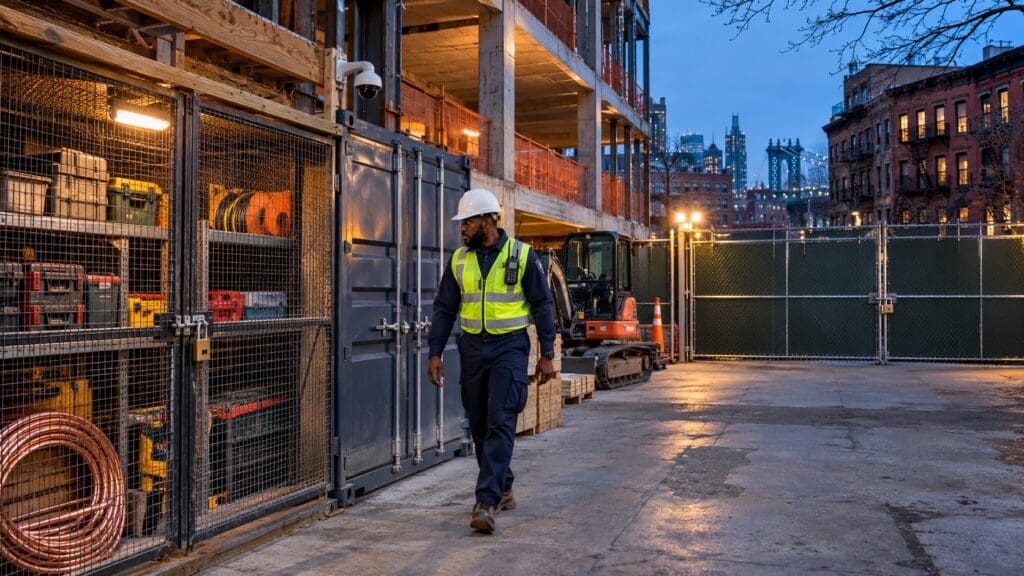
Construction sites can reduce tool, copper, material, and equipment theft by combining a secured perimeter, controlled access, locked storage, equipment identification, lighting, cameras, documented closing procedures, and professional after-hours security.
No single measure is enough. A fence may delay unauthorized entry, but it will not protect an unlocked storage container. A camera may record a theft, but it cannot question someone entering through an open gate. A guard may patrol effectively, but only when the site has clear post orders and reliable inventory records.
The strongest approach uses multiple layers that make unauthorized access, removal, and resale more difficult.
Why Construction Sites Attract Theft
Brooklyn construction sites change constantly. Gates move, subcontractors rotate, deliveries arrive at different hours, walls open and close, and materials shift between floors.
That activity can make it difficult to distinguish legitimate movement from unauthorized removal.
Potential targets include:
- Cordless power tools
- Generators and compressors
- Copper wire and piping
- Electrical cable
- Plumbing fixtures
- HVAC components
- Fuel
- Scaffolding components
- Ladders
- Small machinery
- Vehicle batteries
- Building materials
- Equipment stored in trailers or containers
The loss is not limited to the replacement cost. A stolen tool, machine, or material shipment can delay a crew, interrupt scheduled work, require emergency purchasing, affect subcontractors, and create additional insurance and administrative work.
Effective construction-site security should therefore protect the project schedule as well as the physical property.
Start With a Site-Specific Theft Assessment
Before assigning a guard or installing another camera, identify how property could leave the site.
Review:
- Pedestrian and vehicle entrances
- Fence condition and possible climbing points
- Loading and delivery areas
- Gaps beside neighboring properties
- Scaffolding access
- Cellar, roof, and rear-yard access
- Temporary doors and windows
- Material-hoist locations
- Storage containers and jobsite trailers
- Lighting conditions
- Camera blind spots
- Tool-charging areas
- Copper and cable-storage locations
- Equipment parking areas
- Routes leading toward nearby streets
The assessment should also consider the current construction phase. Theft risks during demolition may differ from those during electrical rough-in, HVAC installation, interior finishing, or final equipment commissioning.
Security coverage should change as the site changes.
1. Maintain a Secure Perimeter
A construction fence is an important first layer, but it needs to be inspected and maintained.
New York City construction requirements generally call for fencing around sites involving new buildings, demolition to grade, open excavation, or other public hazards. Depending on the project, solid construction fencing must meet requirements concerning height, materials, gates, viewing panels, permits, and public access.
Site management should routinely check for:
- Loose or damaged fence panels
- Gaps beneath the fence
- Weak corners
- Missing fasteners
- Objects that can be used for climbing
- Unsecured viewing panels
- Gates that no longer close correctly
- Fence damage hidden behind dumpsters or stored materials
- Access from neighboring properties
The NYC Department of Buildings’ construction-fence guidance explains that gates should be limited to necessary access points. Under the applicable NYC construction provisions, gates generally need to remain closed except during active entry, exit, loading, or unloading.
Security personnel should report damage immediately rather than simply noting it at the end of the shift.
2. Control Every Entrance
A locked main gate is not enough when workers, delivery drivers, subcontractors, vendors, and inspectors use multiple access points.
Create a written access procedure that identifies:
- Approved entrances
- Operating hours
- Who may open the gate
- Who may authorize after-hours access
- Contractor identification requirements
- Delivery-verification procedures
- Visitor sign-in requirements
- Vehicle-entry procedures
- Rules for removing tools and materials
- Emergency-access arrangements
Every person on-site should be able to explain why they are there, whom they are meeting, and what they are bringing in or taking out.
This does not require treating every worker as a suspect. It creates a consistent record that protects workers, subcontractors, and the project.
3. Use a Tool and Equipment Removal Process
The same gate used for deliveries may also become the easiest route for unauthorized property removal.
Create a removal procedure for:
- Power tools
- Copper and cable
- Mechanical equipment
- Generators
- Ladders
- Building materials
- Scrap metal
- Rented equipment
- Company vehicles
Depending on the project, the process may include a signed removal slip, supervisor approval, equipment serial number, vehicle plate, time of removal, and name of the person taking possession.
Guards should not be expected to recognize every tool owned by every contractor. They need a reliable authorization process.
Without that process, a person carrying a drill, coil of cable, or toolbox out of the site may appear completely normal.
4. Secure Tools at the End of Every Shift
Leaving tools scattered across floors makes closing procedures difficult and increases the number of items that guards must monitor.
Establish secured storage areas such as:
- Locked jobsite containers
- Reinforced tool cages
- Locked rooms
- Secured trailers
- Gang boxes anchored to a fixed point
- Contractor-specific storage zones
- Locked charging cabinets where appropriate
High-value portable tools should not remain visible near windows, gates, sidewalk sheds, or ground-floor openings.
At the end of the workday, supervisors should confirm that tools are:
- Returned to the correct storage area
- Counted or checked against the assigned inventory
- Locked properly
- Removed from public view
- Documented when temporarily assigned off-site
Locks and containers should also be inspected. A premium lock attached to a weak hinge or thin container wall may provide little protection.
5. Protect Copper and Other High-Value Materials
Copper, wire, and piping require special attention because they can be cut into smaller sections and removed gradually.
Risk can increase when materials are:
- Delivered too early
- Stored close to a gate
- Left on lower floors
- Visible from outside the site
- Placed in an unlocked room
- Recorded only by shipment totals
- Mixed with scrap material
- Accessible after subcontractors leave
Consider scheduling deliveries closer to installation, dividing materials into controlled storage areas, limiting key access, and recording who receives and releases stock.
Scrap copper should also be controlled. If workers cannot distinguish approved scrap removal from unauthorized material removal, enforcement at the gate becomes inconsistent.
6. Secure Machinery, Vehicles, and Fuel
Larger equipment is harder to carry, but it can still be driven, towed, dismantled, or loaded onto another vehicle.
Protect equipment by:
- Removing keys after each shift
- Keeping keys in a controlled cabinet
- Recording who signs keys in and out
- Using manufacturer-approved immobilization
- Parking equipment away from gates
- Blocking equipment with other secured machinery when appropriate
- Tracking fuel use
- Locking fuel-storage areas
- Recording equipment serial numbers
- Photographing identifying features
- Using GPS or telematics when available
Do not leave keys hidden inside a cab, toolbox, wheel well, or nearby trailer. A predictable hiding place is not access control.
7. Improve Lighting Without Creating Blind Spots
Lighting supports guards and cameras, but more light does not automatically mean better visibility.
Inspect the site after dark and look for:
- Deep shadows behind containers
- Dark stairwells
- Unlit rear corners
- Glare affecting cameras
- Lights blocked by scaffolding
- Damaged temporary fixtures
- Motion lights that activate too late
- Areas where unauthorized individuals can move without crossing a lit zone
Prioritize gates, storage areas, equipment parking, ground-floor openings, trailers, and common perimeter routes.
Temporary lighting should be installed and maintained safely by qualified personnel. Security staff should report outages promptly and document any area that becomes difficult to monitor.
8. Position Cameras Around Movement, Not Just Property
Cameras should capture how people and property move through the site.
Useful coverage may include:
- Faces entering through pedestrian gates
- Vehicles entering and leaving
- License plates where practical
- Storage-container doors
- Tool cages
- Copper-storage areas
- Trailers
- Equipment parking
- Ground-floor access
- Loading zones
- Stair or hoist access
Review nighttime footage before relying on the system. A camera that works well during the day may become ineffective because of darkness, glare, rain, dust, vibration, or a changed construction layout.
Cameras should support the security operation, not replace it. Someone must know who receives alerts, when footage is reviewed, how long recordings are retained, and what happens when a camera goes offline.
9. Assign Guards Clear Patrol Responsibilities
A guard who remains at one desk may miss activity at the rear gate, storage container, upper floor, or equipment area.
Written post orders should identify:
- Guard post locations
- Patrol routes
- Patrol frequency
- Areas requiring special attention
- Gate-opening procedures
- Delivery and visitor requirements
- Tool-removal authorization
- Key-control responsibilities
- Alarm and camera procedures
- Emergency contacts
- When to contact management or police
- Incident-reporting expectations
Patrol routes should vary enough to avoid becoming entirely predictable while still covering every required checkpoint.
Digital patrol verification can help confirm when key areas were checked. However, guards should not be encouraged to rush between checkpoints simply to complete a scan.
Churchgate Protective Services provides construction and commercial security services that can include access monitoring, patrols, site documentation, and supervisor-supported coverage.
10. Use a Documented Closing Checklist
The transition between the daytime crew and overnight security is one of the most important points in the security plan.
A closing supervisor should confirm:
- Workers and subcontractors have exited
- Visitors are accounted for
- Tools are secured
- Copper and high-value materials are locked
- Equipment keys are controlled
- Machinery is parked and immobilized
- Trailers and containers are locked
- Temporary doors and windows are secured
- Cameras and alarms are operational
- Lighting is functioning
- Gates are closed and locked
- Unusual conditions are reported to the guard
- Authorized after-hours workers are identified
Both the site representative and security officer should understand the condition in which the site was handed over.
This prevents confusion when an item was already missing, a door was intentionally left open, or a subcontractor was scheduled to return later.
11. Strengthen Weekend and Holiday Coverage
Security plans often focus on ordinary weeknights even though weekends, holidays, weather interruptions, and project shutdowns may leave the site unattended for longer periods.
Before an extended closure:
- Remove unnecessary portable tools
- Reduce visible stock
- Confirm backup power for security systems
- Test alarms and cameras
- Review the emergency contact list
- Inspect locks, gates, and fencing
- Secure loose construction material
- Confirm guard schedules
- Identify authorized visitors
- Increase patrol attention around high-value areas
- Notify security about schedule changes
NYC Buildings also advises contractors and developers to secure loose tools, electrical equipment, construction fencing, scaffolding, netting, and materials when preparing sites for severe weather.
12. Create an Incident Response and Evidence Plan
The response should be clear before a theft or attempted entry occurs.
The plan should explain:
- When guards should call 911
- Who in management must be notified
- How the scene should be protected
- Who can access CCTV footage
- How video is preserved
- How serial numbers and inventory records are retrieved
- Who communicates with subcontractors
- How damaged locks or fencing are repaired
- How insurance documentation is prepared
- When security procedures must be reviewed
After an incident, avoid immediately cleaning, moving, or repairing everything before evidence is documented—unless an unsafe condition requires urgent action.
Preserve:
- Video from before, during, and after the event
- Access logs
- Delivery and removal records
- Guard reports
- Patrol data
- Photographs
- Equipment serial numbers
- Vehicle descriptions
- Witness information
- Relevant alarm records
The NYPD offers crime-prevention resources and property-security assessments through local precinct crime prevention officers. Information is available through the department’s Security and Safety Services.
Common Construction Security Mistakes
Avoid relying on:
- A fence that is never inspected
- One lock for every subcontractor
- Cameras that no one monitors
- Tools left throughout the building
- Copper stored beside a loading gate
- Keys hidden inside equipment
- A guard without written post orders
- Delivery drivers entering without verification
- Workers removing property without documentation
- Predictable patrols
- An outdated emergency contact list
- Verbal-only incident reporting
- Daytime procedures that stop when supervisors leave
Most theft-prevention failures are not caused by one missing security product. They happen when several small gaps align.
Frequently Asked Questions
Do all Brooklyn construction sites need a security guard?
Not every site requires a full-time guard. The appropriate coverage depends on the site layout, construction phase, materials, equipment, access points, neighborhood conditions, working hours, previous incidents, and insurance or contract requirements.
Some sites use overnight guards, while others combine mobile patrols, cameras, alarms, secured storage, and targeted coverage during higher-risk phases.
When is a construction site most vulnerable?
Risk may increase after workers leave, during weekends and holidays, following major deliveries, during electrical or mechanical installation, and when high-value materials remain on-site before installation.
The security plan should be reviewed whenever the project enters a new phase.
Can cameras replace an overnight security guard?
Cameras can record activity and generate alerts, but they cannot always verify credentials, inspect a damaged gate, redirect an unauthorized visitor, or physically observe areas outside their field of view.
Many sites benefit from combining technology with trained personnel.
Should guards inspect workers’ vehicles or bags?
Search procedures involve legal, contractual, labor, privacy, and workplace-policy considerations. They should not be improvised by an individual guard.
Any inspection policy should be written, consistently applied, communicated in advance, and reviewed by qualified legal counsel and relevant project stakeholders.
What should be included in a construction security report?
Reports should document patrols, gate activity, visitors, deliveries, removals, damaged fencing, open doors, lighting failures, camera issues, unusual activity, incidents, actions taken, and people notified.
Protect the Site Before the Next Shift Begins
Construction-site security works best when it is built into everyday operations.
Secure the perimeter. Control the gate. Document property movement. Lock high-value materials. Verify patrols. Preserve evidence. Review the plan as the project changes.
Churchgate Protective Services provides professional unarmed security support for construction sites throughout Brooklyn and New York City. Coverage can include:
- Gate and access monitoring
- Contractor and visitor verification
- Interior and perimeter patrols
- Tool and material-removal procedures
- Storage and equipment-area checks
- After-hours coverage
- Digital patrol verification
- Incident and activity reporting
- Supervisor-supported security operations
Learn more about protecting your project through after-hours construction security or contact Churchgate Protective Services to discuss your site, work schedule, construction phase, and current security concerns.