Can Tenants Demand a Security Guard in NYC? What Landlords and Residents Should Know
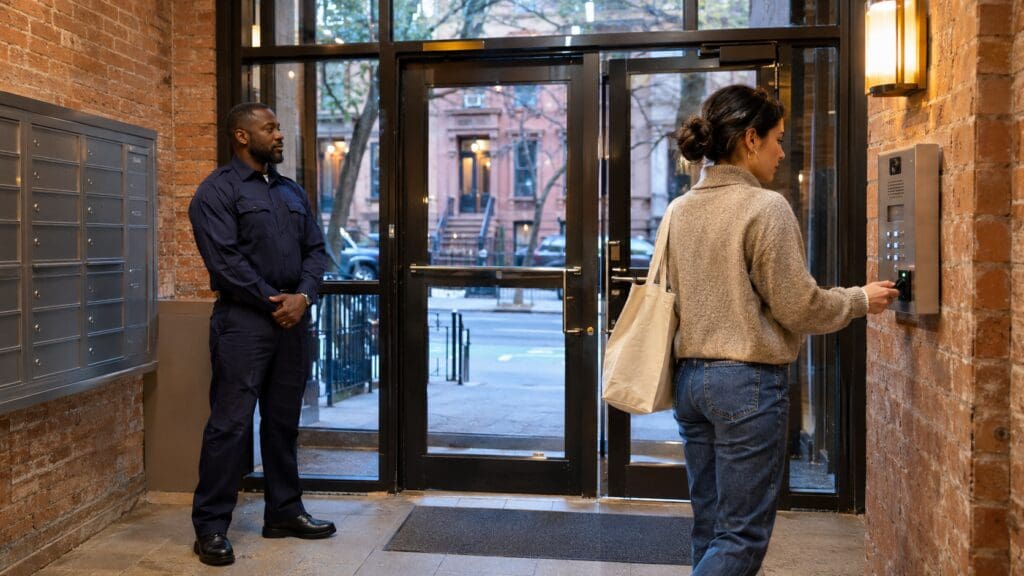
Tenants in New York City generally do not have an automatic right to require their landlord to provide a security guard. Landlords must maintain legally required security measures and take reasonable precautions against foreseeable risks, but those duties do not normally mean every apartment building must employ a guard.
The answer may change when a guard is promised in the lease, is an established service in a rent-regulated building, is required by a court order or agreement, or may be a reasonable response to documented and recurring security problems.
Because every building and incident is different, landlords and tenants should seek qualified legal advice about their specific situation.
The Short Answer
A tenant can ask for a security guard, and tenants can collectively present evidence supporting the request. However, a landlord is not automatically required to hire one simply because residents feel unsafe.
Landlords are generally responsible for maintaining required building-security features, including functioning entrance locks, doors, intercoms, lighting, and other applicable measures. NYC describes property owners as responsible for maintaining security measures and keeping common areas safe and properly maintained. Buildings
Whether a guard is required may depend on:
- The building’s lease agreements
- Whether the apartments are rent regulated
- Services historically provided to tenants
- Known criminal activity
- Previous security incidents
- Broken or ineffective access controls
- Notices and complaints sent to management
- Court orders or settlement agreements
- Government program requirements
- The specific risks presented by the property
What Security Measures Must NYC Landlords Maintain?
Landlords are expected to keep residential buildings reasonably secure and comply with the NYC Housing Maintenance Code, New York State Multiple Dwelling Law, leases, and other applicable requirements.
Depending on the building, required security measures may include:
- Functioning entrance-door locks
- Self-closing and self-locking entrance doors
- Intercommunication or intercom systems
- Properly maintained apartment locks
- Door viewers or peepholes
- Chain-door guards
- Adequate lighting in common areas
- Safe and maintained common spaces
For example, qualifying buildings containing eight or more dwelling units must have an intercommunication system at the main entrance that allows residents to communicate with visitors and release the entrance-door lock from their apartments. nyc.gov
The applicable rules can depend on the building’s size, age, classification, and construction history.
Does the Warranty of Habitability Require a Guard?
New York’s warranty of habitability provides that rented homes and their common areas must be fit for their intended use and free from conditions that are dangerous or harmful to occupants’ life, health, or safety. NYSenate.gov
This does not automatically translate into a right to a security guard. However, serious security defects—such as an entrance door that repeatedly fails to lock—may raise habitability, maintenance, or negligence concerns.
Tenants should distinguish between:
- A request for an additional service, such as adding a new lobby guard
- A demand to repair an existing legal violation, such as a broken lock
- A complaint about the removal of an established service
- A request based on specific, documented and foreseeable risks
These situations may carry different legal consequences.
When Could a Landlord Be Responsible for Building Security?
New York courts have recognised that landlords may have a duty to take minimal precautions against foreseeable harm, including certain foreseeable criminal conduct.
In a 2023 decision, the New York Court of Appeals discussed a landlord’s duty to provide basic security measures such as functioning exterior-door locks. The decision does not mean landlords must prevent every crime or provide a guard in every building. Instead, potential responsibility depends on factors such as the security condition, foreseeability, notice, negligence, and connection between the alleged failure and the injury. nycourts.gov
Landlords should take documented complaints seriously, particularly when reports involve:
- Repeated unauthorized entry
- Broken entrance doors
- Nonfunctioning locks or intercoms
- Trespassing in common areas
- Package theft
- Vandalism
- Threats against tenants or employees
- Assaults or robberies
- Illegal activity in or around the property
- Poor lighting at entrances
- Individuals sleeping or gathering in restricted areas
Hiring a guard may be one possible response, but it is not the only one. A reasonable plan may also include repairing doors, improving access control, adding lighting, repositioning cameras, changing key-management procedures, or coordinating with the local NYPD precinct.
When Tenants May Have a Stronger Basis for Requesting a Guard
1. The Lease Promises Security Personnel
If the lease or another written agreement specifically promises a doorman, lobby attendant, concierge, or security guard, removing or failing to provide that service may create a contractual issue.
The exact wording matters. A promise of a “24-hour doorman” may not mean the same thing as a general statement that the building has security features.
Tenants should review:
- The lease
- Lease riders
- Building rules
- Renewal documents
- Marketing materials incorporated into the agreement
- Written communications from management
2. Security Was an Established Service in a Rent-Regulated Building
Owners of rent-regulated apartments may be required to maintain certain services previously provided or legally required.
New York State Homes and Community Renewal provides a process for tenants to report decreases in building-wide services. Its forms specifically identify doorman and security services among the services that may be addressed in a rent-reduction application. Homes and Community Renewal
This does not mean every rent-stabilized building must add a new guard. It means removing or reducing an established service may raise a different issue from a request to create a service that never existed.
3. There Is a Court Order or Settlement
A court order, consent agreement, regulatory agreement, or settlement may require specific security measures. Both owners and tenants should review the exact terms before deciding whether a guard is required.
4. Documented Conditions Create a Foreseeable Risk
A repeated pattern of intrusions or violent incidents may justify a professional risk assessment. Whether the landlord must hire a guard remains fact-specific, but documented notice makes it more difficult to ignore a known security problem.
5. The Building Is Subject to Special Program Requirements
Some affordable-housing programs, supportive-housing facilities, shelters, senior residences, or other regulated properties may have contracts or operational requirements beyond the rules applying to an ordinary apartment building.
Residents and managers should review the relevant regulatory documents rather than assume the same rule applies everywhere.
What Should Tenants Do When They Feel Unsafe?
Step 1: Report Immediate Danger
Call 911 when there is a crime in progress, an immediate threat, a fire, or a medical emergency.
Do not confront a potentially dangerous person solely to gather evidence.
Step 2: Document the Security Problem
Maintain a written record that includes:
- Date and time
- Location
- Description of the condition or incident
- Police report or complaint number, if available
- Photographs of broken doors or locks
- Video or camera information
- Witness names
- Previous communications with management
- Management’s response
Avoid publishing accusations or identifiable footage online without considering privacy, safety, and legal concerns.
Step 3: Notify the Landlord in Writing
Send a clear written notice to the owner, property manager, or superintendent.
The notice should explain:
- What happened
- Whether it has happened before
- Which security feature failed
- Whether police were contacted
- What corrective action is requested
- When a response is requested
Tenants may ask for a guard while also requesting immediate repairs to doors, locks, intercoms, lighting, or cameras.
Step 4: Report Broken Security Equipment
HPD advises owners to repair broken locks and intercoms promptly to help prevent unauthorized access. HPD
If the owner does not respond, tenants can report qualifying housing-maintenance or safety conditions through NYC 311 or review the HPD maintenance-complaint process. HPD may inspect the condition and issue a violation when appropriate. HPD
A 311 or HPD complaint may address a broken lock or door. It does not necessarily result in an order requiring the landlord to hire a guard.
Step 5: Organize With Other Tenants
Tenants may create a tenant association and collectively raise concerns about recurring security problems. NYC’s tenant guidance recognises tenants’ right to organize and take action when their housing rights are violated. nyc.gov
A group request may include:
- A timeline of incidents
- Copies of police reports
- Photographs of defective conditions
- A list of affected residents
- Proposed security improvements
- A request for a meeting with management
Step 6: Request a Security Assessment
Instead of demanding only one solution, tenants may request a professional assessment covering:
- Entrance locks
- Intercoms
- Cameras
- Exterior lighting
- Package controls
- Visitor procedures
- Key and access-card management
- Guard coverage
- Emergency communication
A security guard may be part of the recommendation, but the assessment could identify more urgent physical problems.
Step 7: Seek Legal Assistance
Tenants may want legal advice when:
- Management ignores serious and repeated conditions
- An established security service is removed
- A lease promise is not honoured
- A tenant suffers an injury
- Retaliation or harassment is suspected
- An HPD violation remains uncorrected
- A rent-regulated service has been reduced
Tenants may be able to bring an HP action in Housing Court to seek repairs or essential services. The appropriate remedy depends on the condition and applicable law. HPD
What Should Landlords Do After Receiving a Security Complaint?
Landlords should not dismiss a complaint simply because the tenant cannot automatically demand a guard.
A responsible response should include:
- Acknowledging the complaint in writing
- Checking doors, locks, intercoms, lighting and cameras
- Reviewing recent incident reports
- Preserving relevant video
- Speaking with building staff and affected tenants
- Correcting physical defects promptly
- Contacting police when criminal activity is reported
- Completing a documented risk assessment
- Considering temporary or permanent guard coverage
- Communicating the corrective plan to residents
Management should avoid promising that any security measure will eliminate crime. The goal is to take reasonable, documented steps proportionate to the known risk.
When Hiring a Guard May Be Appropriate
Guard coverage may be worth considering when a building experiences:
- Recurring unauthorized entry
- Repeated package or property theft
- Threats against residents or staff
- A pattern of vandalism
- High visitor or delivery volume
- Construction that affects normal entrances
- An extended access-control failure
- Large gatherings or sensitive events
- Overnight activity in common areas
- A period of elevated and documented risk
Coverage does not always need to be permanent or around the clock. Options may include:
- Evening lobby coverage
- Overnight guards
- Mobile patrols
- Weekend coverage
- Temporary guards during repairs
- Peak delivery-hour coverage
- A combination of concierge and patrol positions
The guard’s duties should be defined in written post orders.
What Security Guards Can and Cannot Do
A professional unarmed guard may help with:
- Monitoring entrances
- Verifying visitors
- Conducting patrols
- Addressing unauthorized access
- Documenting incidents
- Contacting management or emergency services
- Assisting residents during emergencies
- Monitoring package and delivery activity
- Checking doors and common areas
A guard cannot guarantee that crime will not occur. Security officers also should not be expected to perform police functions beyond their authority or training.
New York security personnel should be properly registered and trained for the work assigned to them. Landlords should verify the provider’s licensing, insurance, supervision, reporting system, and replacement-staffing procedures.
Alternatives and Supplements to a Full-Time Guard
Depending on the risk assessment, a landlord may consider:
- Repairing entrance locks and self-closing doors
- Upgrading the intercom
- Improving exterior and hallway lighting
- Installing or repositioning cameras
- Using access cards or controlled keys
- Creating visitor-management procedures
- Securing package rooms
- Hiring mobile patrols
- Adding temporary guard coverage
- Training building staff
- Coordinating with the local NYPD precinct
Technology and guards work best as parts of a layered plan—not as isolated solutions.
Frequently Asked Questions
Can tenants vote to require a security guard?
A tenant vote can demonstrate collective concern, but it does not automatically create a legal obligation to hire a guard. A majority request may matter for certain building-security equipment under specific laws, but that is different from requiring security personnel.
Can tenants withhold rent until a guard is hired?
Withholding rent can have serious legal consequences. Tenants should obtain legal advice before taking that step. A request for a new guard is not necessarily treated the same as an unresolved housing-code violation.
Can a landlord remove an existing security guard?
Possibly, but the answer may depend on the lease, rent-regulation status, established services, and other agreements. Rent-regulated tenants may have remedies when a required or established building-wide security service is reduced.
Does repeated package theft require a guard?
Not automatically. However, repeated theft should lead to a documented review of package procedures, doors, cameras, lighting, visitor controls, and staffing. A guard may be recommended when other measures are insufficient or the risk is elevated.
Does a broken lobby lock require a security guard?
The immediate obligation will usually focus on repairing the lock and restoring required access control. Temporary guard coverage may be a reasonable precaution during a prolonged failure, but whether it is legally required depends on the circumstances.
Can a landlord charge tenants for a guard?
The answer depends on the lease, rent-regulation rules, and how the service is introduced. Landlords should obtain legal guidance before adding fees or passing costs to tenants.
Can a tenant install an additional apartment lock?
Tenants in qualifying multiple dwellings generally have the right to install an additional apartment-door lock, subject to size and duplicate-key requirements. nyc.gov Tenants must still comply with fire-safety and egress requirements.
Build a Practical Security Plan for Your NYC Property
NYC tenants cannot usually demand a security guard solely based on a general feeling of insecurity. But landlords should respond seriously to documented threats, repeat incidents, broken access controls, and established security obligations.
The right solution may involve repairs, cameras, lighting, stronger access procedures, trained guards, or a combination of these measures.
Churchgate Protective Services provides professional unarmed guards, lobby security, access control, mobile patrols, visitor management, and digital incident reporting for residential properties throughout Brooklyn and New York City.
Churchgate Protective Services
747 Lexington Ave., Suite 1
Brooklyn, NY 11221
Phone: (718) 498-5960
Email: info@churchgatecorp.com
Website: churchgateprotective.com
This article provides general information and is not legal advice. Landlords and tenants should consult a qualified New York attorney about their specific rights and obligations.